Antibody Isotypes and IgG Subclasses Explained (IgG1, IgG2a, IgM and More)
Antibody isotypes and IgG subclasses help explain why antibodies protect the body in different ways. The five main types of immunoglobulins—IgG, IgA, IgM, IgE, and IgD—have distinct structures and roles in immune defense. IgG also includes subclasses that differ in receptor binding, complement activation, and immune responses. Understanding human IgG subclasses and mouse IgG subclasses is especially important because IgG1 and IgG2a aren't directly equivalent across species. This guide explains antibody structure and function, compares major antibody classes, and shows how to choose suitable isotypes and detection reagents for reliable laboratory research.
What Are Antibody Isotypes and Immunoglobulin Subclasses?
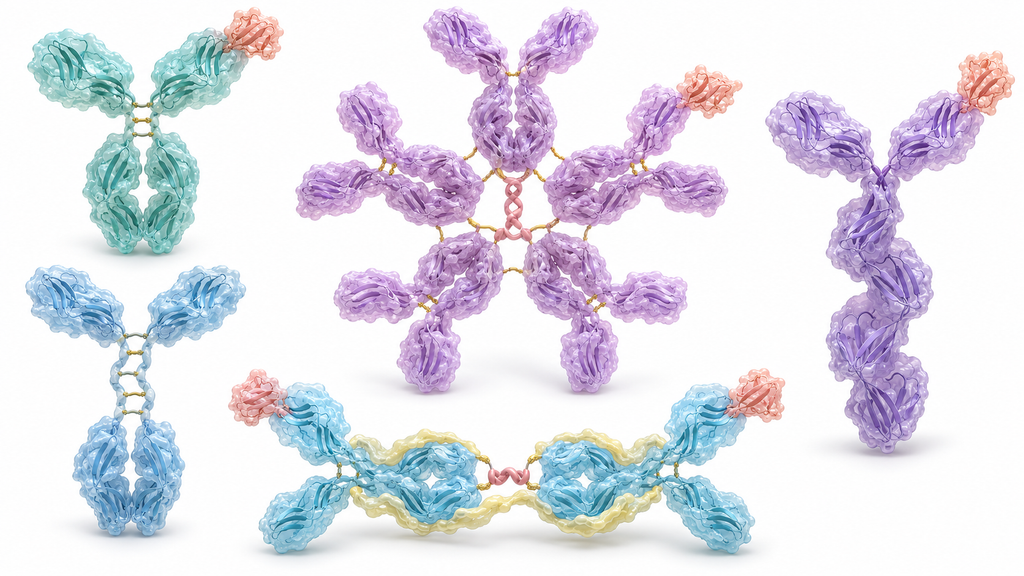
Antibody isotypes are classes of immunoglobulins defined by their heavy-chain constant regions. The five main classes are IgG, IgA, IgM, IgE, and IgD. Each supports different parts of the humoral immune response.
Antibody isotypes and IgG subclasses aren't the same. An isotype identifies the main antibody class, while a subclass describes a smaller group within that class. These differences influence immune activity and laboratory detection.
What Is the Difference Between an Isotype and a Subclass?
An isotype determines the antibody's main class. A subclass identifies differences within that class. Humans have four IgG subclasses and two IgA subclasses, each with distinct structural and functional properties.
What Are Antibody Allotypes?
Antibody allotypes are inherited variations in immunoglobulin constant regions among individuals of the same species. Unlike isotypes or subclasses, allotypes don't define the antibody's main functional class.
You can explore AbTriva's research antibody collection to compare antibody types and available research applications.
Antibody Structure: Heavy Chains, Light Chains, Fab, and Fc Regions
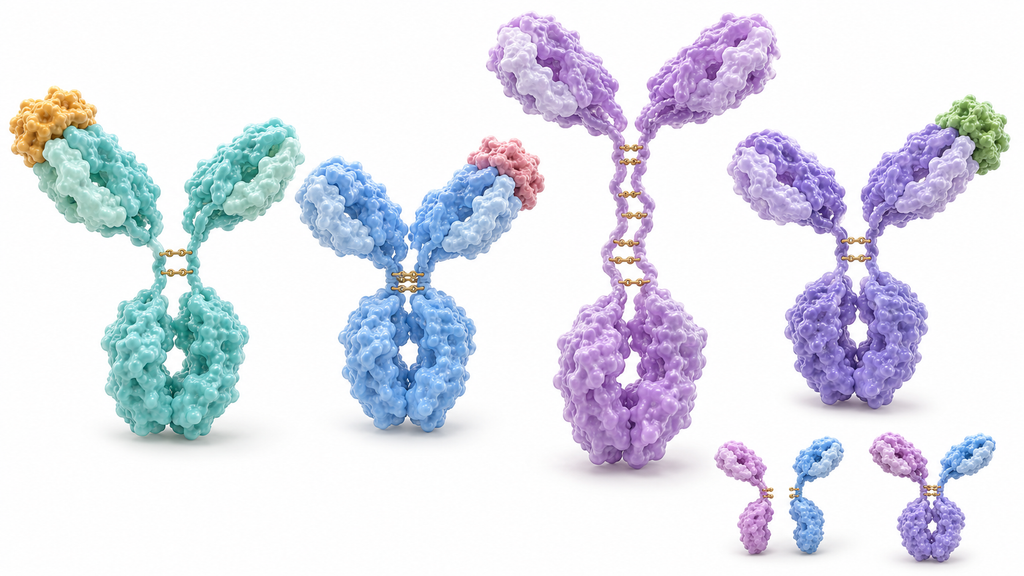
Most antibodies contain two immunoglobulin heavy chains and two light chains connected by disulfide bonds. Their Y-shaped structure allows antigen recognition while supporting interactions with immune cells.
Understanding antibody structure and function helps explain why subclasses behave differently. Changes in the constant region affect receptor binding, complement activation, and molecular stability without necessarily changing antigen specificity.
Heavy Chains and Light Chains
The heavy chain determines antibody class, while kappa and lambda light chains contribute to antigen recognition. Both contain variable and constant regions that support binding and structural stability.
Fab and Fc Regions
Fab and Fc fragments serve different roles. Fab regions recognize antigens, while the Fc region interacts with immune receptors and complement proteins to trigger biological responses.
Hinge Region and Disulfide Bonds
The hinge connects Fab arms to the Fc region. Hinge region flexibility affects antigen accessibility, while interchain disulfide bonds help maintain antibody structure.
For laboratory comparisons, AbTriva's monoclonal antibody collection provides examples of antibodies with defined clone identities.
Five Types of Antibodies and Their Functions: IgG, IgA, IgM, IgE, and IgD
The five types of antibodies protect the body through different mechanisms. Some circulate in blood, while others concentrate at mucosal surfaces or participate in allergic responses.
Understanding IgG IgA IgM IgE IgD functions helps researchers interpret immune responses and select the correct immunoglobulin targets for biological studies.
IgG: Long-Term Immune Protection
Immunoglobulin G is the most abundant antibody class in human serum. It supports antigen neutralization, pathogen clearance, and immune memory. IgG can also cross the placenta through FcRn-mediated transport.
IgA: Protection at Mucosal Surfaces
Immunoglobulin A protects mucosal surfaces, including the respiratory and digestive tracts. Secretory IgA commonly forms dimers that help prevent pathogens from attaching to epithelial cells.
IgM: Early Immune Response
Immunoglobulin M is commonly produced early during immune activation. Secreted pentameric IgM binds multiple antigen sites and efficiently activates the classical complement pathway.
IgE and IgD: Specialized Immune Roles
Immunoglobulin E interacts with mast cells and basophils during allergic and parasite-related responses. Immunoglobulin D is mainly expressed on mature naïve B cells and contributes to immune signaling.
Immunoglobulin Comparison Chart
Antibody Class
Heavy Chain
Main Function
Common Form
IgG
Gamma (γ)
Neutralization, opsonization, immune protection
Monomer
IgA
Alpha (α)
Mucosal protection
Monomer or dimer
IgM
Mu (μ)
Early response, complement activation
Pentamer in serum
IgE
Epsilon (ε)
Allergy and parasite defense
Monomer
IgD
Delta (δ)
B-cell receptor signaling
Monomer
Researchers comparing antibody formats can also review AbTriva's polyclonal antibody collection for products suitable for different detection methods.
Human IgG Subclasses Explained: IgG1, IgG2, IgG3, and IgG4
The four human IgG subclasses differ mainly in their constant regions, hinge structures, and immune receptor interactions. IgG1 is the most abundant, followed by IgG2, IgG3, and IgG4.
Understanding IgG1 IgG2 IgG3 IgG4 differences helps explain why antibodies recognizing similar antigens may produce different immune responses.
IgG1: The Most Abundant Human Subclass
Human IgG1 commonly responds to protein antigens. It supports antibody-dependent cellular cytotoxicity and phagocytosis through Fc receptor interactions. It also activates complement under suitable conditions.
IgG2: Response to Polysaccharide Antigens
Human IgG2 is particularly important for responses to bacterial polysaccharide antigens. Its relatively rigid hinge influences antigen binding, and its complement activation is generally weaker than IgG1 or IgG3.
IgG3: Strong Complement Activation
Human IgG3 has a long, flexible hinge and generally binds C1q efficiently. This supports strong complement activation, although its stability and circulating half-life can differ between genetic variants.
IgG4: Limited Complement Activation
Human IgG4 generally shows weak complement activation and can undergo IgG4 Fab-arm exchange. This process creates antibodies with two different antigen-binding specificities and may reduce immune complex formation.
Human IgG Subclass Comparison
Subclass
Approximate Serum Abundance
Complement Activation
Main Characteristic
IgG1
60%
Strong
Common response to protein antigens
IgG2
32%
Relatively weak
Polysaccharide responses
IgG3
4%
Very strong
Long, flexible hinge
IgG4
4%
Minimal
Fab-arm exchange
These are approximate adult proportions and can vary between individuals.
Mouse IgG Subclasses: IgG1, IgG2a, IgG2b, IgG2c, and IgG3
Mouse IgG subclasses differ from human subclasses in both naming and biological activity. Mouse IgG1, IgG2a, IgG2b, IgG2c, and IgG3 have distinct Fc receptor interactions.
Understanding IgG1 vs IgG2a and IgG2a vs IgG2b is especially important when designing mouse immunology studies or selecting subclass-specific detection reagents.
Mouse IgG1 and IgG2a
Mouse IgG1 generally produces weaker activating Fc receptor responses than IgG2a. Mouse IgG2a often supports stronger Fc-mediated immune activity, although results depend on receptor expression and experimental conditions.
Mouse IgG2b and IgG3
Mouse IgG2b can support complement activation and interactions with activating Fc receptors. Mouse IgG3 has distinctive properties, including a tendency to form immune complexes under certain conditions.
Why Mouse IgG2c Matters
Mouse strain differences affect subclass expression. BALB/c mice commonly express IgG2a, while C57BL/6 mice typically express IgG2c instead. These subclasses are related but shouldn't be treated as identical.
How Antibody Isotypes and IgG Subclasses Affect Immune Functions
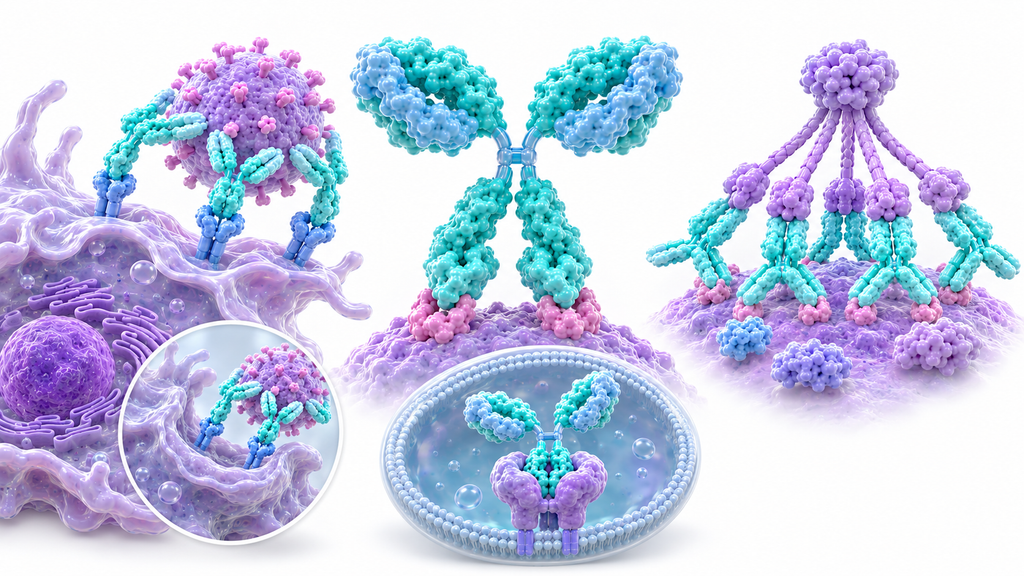
Antibody isotypes and IgG subclasses influence how immune cells recognize and remove pathogens. Their Fc regions interact with receptors and complement proteins, producing different biological effects.
These antibody effector functions depend on subclass structure, receptor availability, antigen arrangement, and Fc glycosylation. Therefore, subclass identity alone doesn't determine the entire immune response.
Fc Gamma Receptors and Immune Cell Activation
Fc gamma receptors bind IgG Fc regions on immune cells. These interactions influence antibody-dependent phagocytosis, cellular cytotoxicity, and inflammatory signaling.
Complement Activation and C1q Binding
C1q binding can activate the classical complement pathway when suitable antibodies bind antigens. Human IgG3 and IgG1 generally activate complement more effectively than IgG2 or IgG4.
FcRn and Antibody Half-Life
The FcRn neonatal receptor protects IgG from degradation and supports transport across certain tissues. Most human IgG subclasses have relatively long circulating half-lives, although IgG3 varies with allotype.
Fc Glycosylation and Immune Activity
Fc glycosylation affects antibody interactions with immune receptors. Changes in fucosylation and galactosylation can influence Fc-mediated functions even when the antibody subclass remains unchanged.
Antibody Cross-Reactivity in Research
Different subclasses don't automatically eliminate off-target binding. Antibody specificity depends on the antigen-binding region and experimental conditions.
How to Choose the Right Antibody Isotype for Research Applications
Antibody isotype selection depends on your experimental method, antibody host, target species, and detection system. For example, mouse IgG1 and IgG2a primary antibodies may require different subclass-specific secondary antibodies.
Understanding antibody isotypes and IgG subclasses also helps you choose suitable experimental controls. Always verify antibody clone, isotype, specificity, and application validation before use.
Primary and Secondary Antibody Compatibility
Your primary antibody isotype determines which secondary antibodies can recognize it. Match the primary's host species and relevant subclass with the secondary's stated specificity.
When Are Isotype-Specific Secondary Antibodies Needed?
Isotype-specific secondary antibodies are useful when distinguishing mouse monoclonal antibodies of different subclasses. Confirm cross-reactivity, because an anti-IgG1 reagent may not be completely selective without proper validation.
Antibody isotype controls may help assess certain nonspecific binding effects. Match the control's host, subclass, fluorochrome, and concentration when appropriate.
However, isotype controls don't replace fluorescence-minus-one controls or biological negative controls.
An antibody suitable for ELISA may not work in flow cytometry. Confirm whether the reagent recognizes native, fixed, or denatured antigens before choosing a detection method.
1. What are the functions of IgG, IgA, IgM, IgD, and IgE?
IgG provides long-term immune protection, IgA protects mucosal surfaces, and IgM supports early immune responses. IgD helps regulate B-cell activity, while IgE participates in allergic reactions and defense against certain parasites. Each antibody class performs specialized functions within the immune system.
NCBI Bookshelf
2. What is the clinical significance of IgG subclasses?
IgG subclasses influence immune responses and help protect against different pathogens. Low IgG2 levels may be associated with recurrent bacterial infections, while abnormal IgG4 levels can support the investigation of IgG4-related disease. Subclass results must be interpreted alongside symptoms and other laboratory findings.
Immune Deficiency Foundation+1
3. What is the difference between IgG1, IgG2, IgG3, and IgG4?
IgG1 is the most abundant human IgG subclass and supports several immune functions. IgG2 is important for responses to bacterial polysaccharides. IgG3 strongly activates complement, while IgG4 has relatively low complement activity and can participate in immune regulation.
PMC
4. What are the immunoglobulin types and their functions?
Immunoglobulins are divided into five classes: IgG, IgA, IgM, IgE, and IgD. IgG supports systemic protection, IgA provides mucosal defense, IgM responds early to infection, IgE participates in allergy and parasite defense, and IgD contributes to B-cell receptor signaling.
5. How can you remember IgM, IgG, IgA, IgD, and IgE?
Use the mnemonic GAMED to remember the five antibody classes: G for IgG, A for IgA, M for IgM, E for IgE, and D for IgD. Associate each class with its main function to make the differences easier to remember.
Conclusion
Understanding antibody isotypes and IgG subclasses helps explain how antibodies recognize antigens, activate immune pathways, and interact with immune cells. IgG, IgA, IgM, IgE, and IgD serve different functions, while human and mouse IgG subclasses have important structural differences.
For reliable research, identify the correct antibody class, species, subclass, and detection method. Choose validated antibodies and compatible secondary reagents, and use appropriate controls to support accurate experimental results.
Fast & Free Shipping
Free shipping on orders $999+
Quality Guarantee
Advenit post multos Scudilo Scutariorum tribunus velament
Secure Payment
We accept credit cards, PayPal, and bank wires
Lifetime Customer Support
Responsive and knowledgable customer service via email, text or phone