A western blot can fail for many reasons, but antibody dilution is one of the most common and most fixable. Too concentrated, and you get smudged background. Too dilute, and your target band barely shows up.
Finding the right dilution is not guesswork. It is a simple, repeatable process that pays off every time you use that antibody again.
This guide walks through how to optimize primary and secondary antibody dilutions for western blot, with practical starting ranges and a clear troubleshooting path.
Why Antibody Dilution Matters
Every antibody has a sweet spot. At that concentration, your target band is strong and clean, and background stays low.
Go above that point, and the antibody starts binding non specifically, lighting up the whole membrane.
Go below it, and there is simply not enough antibody to produce a visible signal.
Starting Dilution Ranges
Manufacturer datasheets give you a starting point, not a guarantee. The real answer depends on your sample, your detection method, and even your specific antibody lot.
Antibody Type
Typical Starting Range
Notes
Primary antibody (unpurified serum)
1:500 to 1:2,000
Wide range, always titrate
Primary antibody (purified, 1 mg/mL)
0.2 to 2 µg/mL
Check datasheet for exact figure
HRP secondary antibody
1:2,000 to 1:10,000
Most common detection range
Fluorescent secondary antibody
1:5,000 to 1:20,000
Often needs less than HRP
Phospho specific primary
0.5 to 2 µg/mL
Add phosphatase inhibitors to diluent
How to Titrate Your Primary Antibody
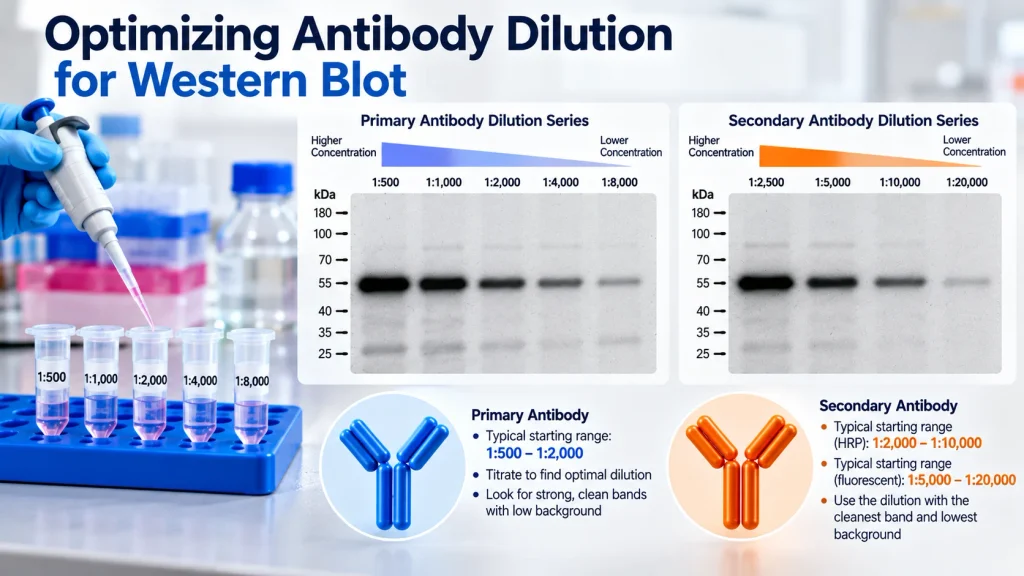
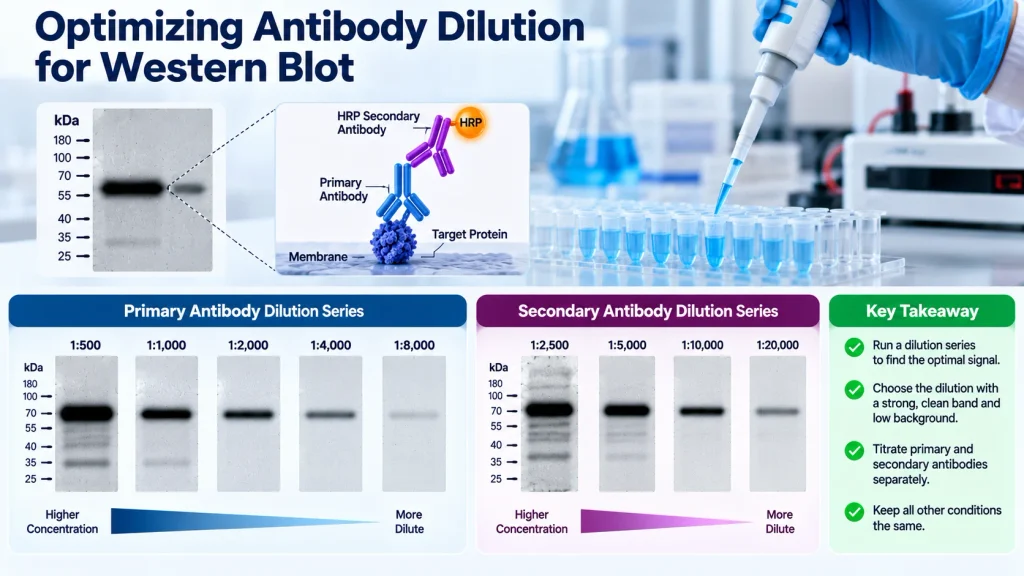
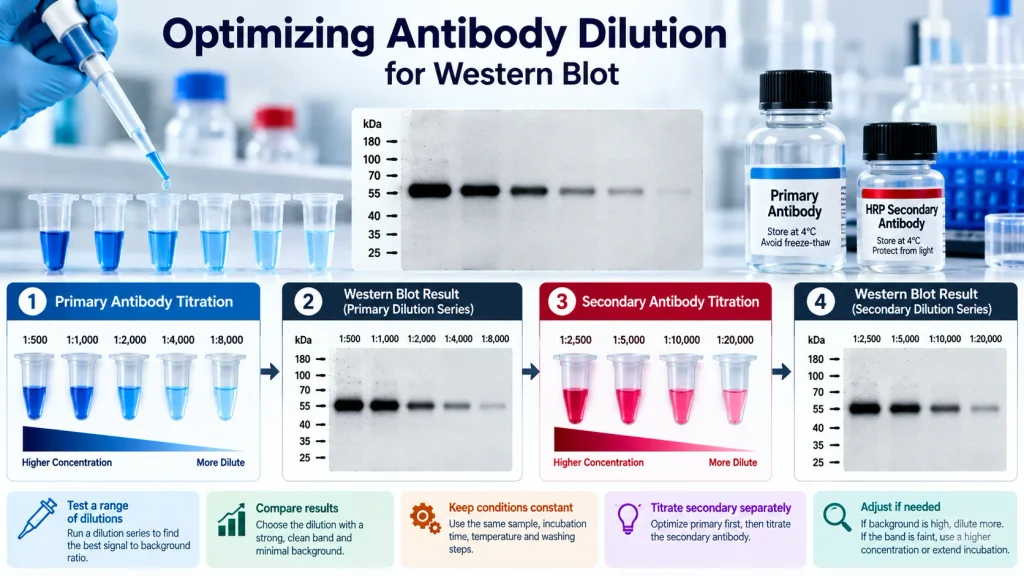
Titration means testing a range of dilutions side by side, then picking the one that gives the cleanest result.
• Choose a dilution series, for example 1:500, 1:1000, 1:2000, 1:4000, and 1:8000
• Run identical samples on separate strips or lanes
• Keep everything else the same, including incubation time, temperature, and washing
• Probe each strip with a different dilution from your series
• Compare band intensity and background across all strips
The winning dilution is the one with a strong, sharp band and minimal background, not necessarily the darkest band overall.
How to Titrate Your Secondary Antibody
Once your primary antibody dilution is set, hold it constant and titrate the secondary the same way.
• Test a series such as 1:2,500, 1:5,000, 1:10,000, and 1:20,000
• Use the same primary antibody concentration across all strips
• Look for the dilution that gives the clearest band with the shortest exposure time
Secondary antibodies are usually the easiest fix for high background, since reducing their concentration rarely affects how well the primary detects its target.
Other Factors That Affect Apparent Dilution
• Diluent choice: avoid diluting antibody in blocking buffer that contains milk if your target is phosphorylated, since milk contains phosphoproteins that can interfere
• Incubation time: longer incubation can sometimes let you use a more dilute antibody
• Temperature: cold room incubation overnight often allows a more dilute primary than a short room temperature incubation
• Sample loading: too much protein loaded can make even a well titrated antibody look oversaturated
Troubleshooting by Symptom
Symptom
Likely Cause
Fix
No band at all
Antibody too dilute, target not present
Increase concentration, confirm protein loaded
Band present but very faint
Antibody under titrated
Reduce dilution factor, extend incubation
Dark background across whole membrane
Antibody over concentrated
Increase dilution factor
Extra bands at unexpected sizes
Non specific binding, antibody too concentrated
Dilute further, increase wash steps
Background in empty lanes
Secondary antibody too concentrated
Reduce secondary concentration first
Frequently Asked Questions
What is the typical primary antibody dilution for western blot
Most primary antibodies are diluted between 1:500 and 1:2,000, depending on the antibody.
What is the typical secondary antibody dilution for western blot
HRP secondary antibodies typically range from 1:2,000 to 1:10,000.
How do I know if my antibody dilution is too concentrated
Dark background across the whole membrane usually means the antibody is too concentrated.
Should I dilute primary and secondary antibodies the same way
No, titrate them separately, since each behaves differently at different concentrations.
What is the fastest way to test antibody dilutions
A dot blot lets you test several dilutions quickly without running full gels.
Can I reuse antibody dilutions for future blots
Yes, diluted primary antibody can often be stored at 4°C and reused several times.
Why does my antibody need a different dilution than the datasheet says
Sample type, detection method, and antibody lot can all shift the optimal dilution.
Fast & Free Shipping
Free shipping on orders $999+
Quality Guarantee
Advenit post multos Scudilo Scutariorum tribunus velament
Secure Payment
We accept credit cards, PayPal, and bank wires
Lifetime Customer Support
Responsive and knowledgable customer service via email, text or phone