-
Chinese (Simplified)
-
English
-
German
-
Korean
-
Spanish
Chinese (Simplified)
English
German
Korean
Spanish
Sign up for an account to enjoy easy online shopping and instant order tracking.
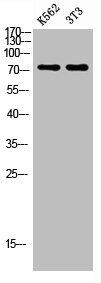
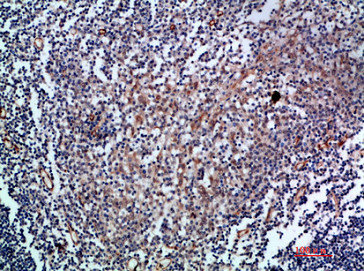
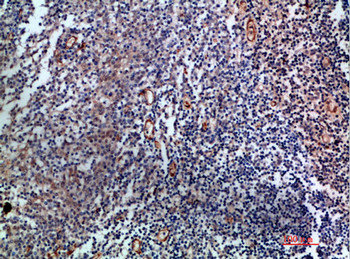
The antibody against ENG was raised in rabbit using the Synthetic peptide from Human protein at AA range: 370-430 as the immunogen. This antibody exists as a non-conjugated antibody. The antibody was affinity-purified from rabbit serum by affinity-chromatography using specific immunogen. This antibody has been validated on WB, IHC, ELISA.
$167.00
| Cat.No | ADC-13021A | Clonality | Polyclonal |
|---|---|---|---|
| Host Species | Rabbit | Target Name | ENG |
| Target Synonyms | ENG; END; Endoglin; CD antigen CD105 | Form | Liquid |
| Species Reactivity | Human | Storage Buffer | PH 7.4, containing 0.02% sodium azide as Preservative and 50% Glycerol., PBS |
| Purification Method | The antibody was affinity-purified from rabbit serum by affinity-chromatography using specific immunogen. | Conjugate | Non-conjugated |
| Application | ELISA, IHC, WB | Storage | Upon receipt |
| Immunogen Description | Synthetic peptide from Human protein at AA range: 370-430 | Target Species | Human |
|---|---|---|---|
| Immunogen Sequence | Complete sequences for the immunogen, target protein, and peptides are available upon request. | Uniprot ID | P17813 |
Uniprot Id
P17813
Target Species
Human
Target Name
ENG
Target Full Name
Endoglin
Target Function
Vascular endothelium glycoprotein that plays an important role in the regulation of angiogenesis. Required for normal structure and integrity of adult vasculature. Regulates the migration of vascular endothelial cells. Required for normal extraembryonic angiogenesis and for embryonic heart development. May regulate endothelial cell shape changes in response to blood flow, which drive vascular remodeling and establishment of normal vascular morphology during angiogenesis. May play a critical role in the binding of endothelial cells to integrins and/or other RGD receptors. Acts as TGF-beta coreceptor and is involved in the TGF-beta/BMP signaling cascade that ultimately leads to the activation of SMAD transcription factors. Required for GDF2/BMP9 signaling through SMAD1 in endothelial cells and modulates TGFB1 signaling through SMAD3.
Target Involvement
Telangiectasia, hereditary hemorrhagic, 1 (HHT1)
Target Subcellular Location
Cell membrane; Single-pass type I membrane protein.
Target Tissue Specificity
Detected on umbilical veil endothelial cells. Detected in placenta (at protein level). Detected on endothelial cells.
Target Synonyms
ENG; END; Endoglin; CD antigen CD105
Target Background
This gene encodes a homodimeric transmembrane protein which is a major glycoprotein of the vascular endothelium. This protein is a component of the transforming growth factor beta receptor complex and it binds to the beta1 and beta3 peptides with high affinity. Mutations in this gene cause hereditary hemorrhagic telangiectasia, also known as Osler-Rendu-Weber syndrome 1, an autosomal dominant multisystemic vascular dysplasia. This gene may also be involved in preeclampsia and several types of cancer. Alternatively spliced transcript variants encoding different isoforms have been found for this gene.
Notification