-
Chinese (Simplified)
-
English
-
German
-
Korean
-
Spanish
Chinese (Simplified)
English
German
Korean
Spanish
Sign up for an account to enjoy easy online shopping and instant order tracking.
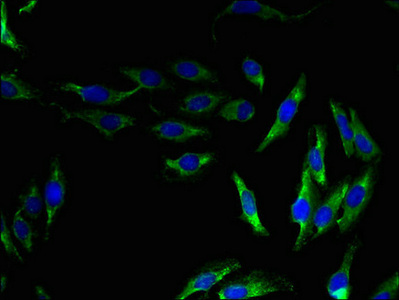
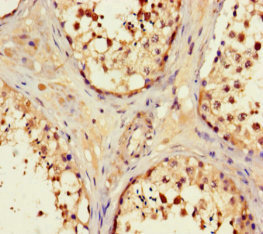
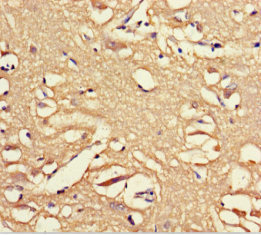
The antibody against OPN5 was raised in rabbit using the Recombinant Human Opsin-5 protein (310-353AA) as the immunogen. This antibody exists as a non-conjugated isotype IgG, purified by protein G with a purity greater than 95%. This antibody has been validated on ELISA, IHC, IF.
$299.00
| Cat.No | ADC-19803A | Clonality | Polyclonal |
|---|---|---|---|
| Host Species | Rabbit | Target Name | OPN5 |
| Target Synonyms | OPN5; GPR136; PGR12; TMEM13; Opsin-5; G-protein coupled receptor 136; G-protein coupled receptor PGR12; Neuropsin; Transmembrane protein 13 | Form | Liquid |
| Species Reactivity | Human | Isotype | IgG |
| Storage Buffer | 0.01M PBS, 0.03% Proclin 300; Constituents: 50% Glycerol, PH 7.4 | Purification Method | >95%, Protein G purified |
| Conjugate | Non-conjugated | Application | ELISA, IF, IHC |
| Storage | Upon receipt |
| Immunogen Description | Recombinant Human Opsin-5 protein (310-353AA) | Target Species | Human |
|---|---|---|---|
| Immunogen Sequence | Complete sequences for the immunogen, target protein, and peptides are available upon request. | Uniprot ID | Q6U736 |
Uniprot Id
Q6U736
Target Species
Human
Target Name
OPN5
Target Full Name
Opsin-5
Target Function
G-protein coupled receptor which selectively activates G(i) type G proteins via ultraviolet A (UVA) light-mediated activation in the retina. Preferentially binds the chromophore 11-cis retinal and is a bistable protein that displays emission peaks at 380 nm (UVA light) and 470 nm (blue light). Required for the light-response in the inner plexiform layer, and contributes to the regulation of the light-response in the nerve fiber layer, via phosphorylated DAT/SLC6A3 dopamine uptake. Involved in local corneal and retinal circadian rhythm photoentrainment via modulation of the UVA light-induced phase-shift of the retina clock. Acts as a circadian photoreceptor in the outer ear, via modulation of circadian clock-gene expression in response to violet light during the light-to-dark transition phase and night phase of the circadian cycle. Required in the retina to negatively regulate hyaloid vessel regression during postnatal development via light-dependent OPN5-SLC32A1-DRD2-VEGFR2 signaling. Involved in the light-dependent regulation of retina and vitreous compartment dopamine levels.
Target Subcellular Location
Cell membrane; Multi-pass membrane protein.
Target Protein Families
G-protein coupled receptor 1 family, Opsin subfamily
Target Tissue Specificity
Detected in brain and retina and cell lines derived from neural retina.
Target Synonyms
OPN5; GPR136; PGR12; TMEM13; Opsin-5; G-protein coupled receptor 136; G-protein coupled receptor PGR12; Neuropsin; Transmembrane protein 13
Target Background
Opsins are members of the guanine nucleotide-binding protein (G protein)-coupled receptor superfamily. This opsin gene is expressed in the eye, brain, testes, and spinal cord. This gene belongs to the seven-exon subfamily of mammalian opsin genes that includes peropsin (RRH) and retinal G protein coupled receptor (RGR). Like these other seven-exon opsin genes, this family member may encode a protein with photoisomerase activity. Alternative splicing results in multiple transcript variants.
Notification