-
Chinese (Simplified)
-
English
-
German
-
Korean
-
Spanish
Chinese (Simplified)
English
German
Korean
Spanish
Sign up for an account to enjoy easy online shopping and instant order tracking.
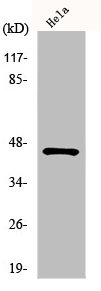
The antibody against HORMAD1 was raised in rabbit using the Synthesized peptide derived from the C-terminal region of Human HORMAD1. as the immunogen. This antibody exists as a non-conjugated isotype IgG. The antibody was affinity-purified from rabbit antiserum by affinity-chromatography using epitope-specific immunogen. This antibody has been validated on WB, ELISA.
$167.00
| Cat.No | ADC-38468A | Clonality | Polyclonal |
|---|---|---|---|
| Host Species | Rabbit | Target Name | HORMAD1 |
| Target Synonyms | HORMAD1 antibody; NOHMA antibody; HORMA domain-containing protein 1 antibody; Cancer/testis antigen 46 antibody; CT46 antibody; Newborn ovary HORMA protein antibody | Form | Liquid |
| Species Reactivity | Human | Isotype | IgG |
| Storage Buffer | 0.5% BSA and 0.02% sodium azide., Liquid in PBS containing 50% glycerol | Purification Method | The antibody was affinity-purified from rabbit antiserum by affinity-chromatography using epitope-specific immunogen. |
| Conjugate | Non-conjugated | Application | ELISA, WB |
| Storage | Upon receipt |
| Immunogen Description | Synthesized peptide derived from the C-terminal region of Human HORMAD1. | Target Species | Human |
|---|---|---|---|
| Immunogen Sequence | Complete sequences for the immunogen, target protein, and peptides are available upon request. | Uniprot ID | Q86X24 |
Uniprot Id
Q86X24
Target Species
Human
Target Name
HORMAD1
Target Full Name
HORMA domain-containing protein 1
Target Function
Plays a key role in meiotic progression. Regulates 3 different functions during meiosis: ensures that sufficient numbers of processed DNA double-strand breaks (DSBs) are available for successful homology search by increasing the steady-state numbers of single-stranded DSB ends. Promotes synaptonemal-complex formation independently of its role in homology search. Plays a key role in the male mid-pachytene checkpoint and the female meiotic prophase checkpoint: required for efficient build-up of ATR activity on unsynapsed chromosome regions, a process believed to form the basis of meiotic silencing of unsynapsed chromatin (MSUC) and meiotic prophase quality control in both sexes.
Target Subcellular Location
Nucleus. Chromosome.
Target Tissue Specificity
Testis-specific. Over-expressed in carcinomas.
Target Synonyms
HORMAD1; NOHMA; HORMA domain-containing protein 1; Cancer/testis antigen 46; CT46; Newborn ovary HORMA protein
Notification