-
Chinese (Simplified)
-
English
-
German
-
Korean
-
Spanish
Chinese (Simplified)
English
German
Korean
Spanish
Sign up for an account to enjoy easy online shopping and instant order tracking.
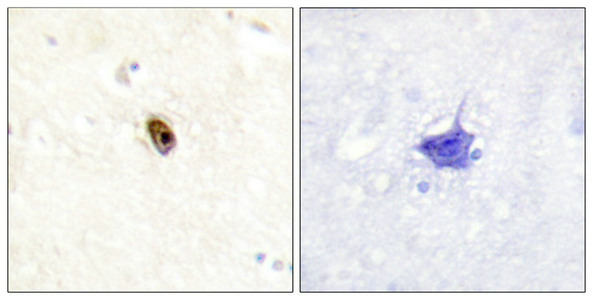
The antibody against AURKC was raised in rabbit using the Peptide sequence around phosphorylation site of threonine 236/202 (C-G-T(p)-L-D) derived from Human AurB/C. as the immunogen. Antibodies were produced by immunizing rabbits with synthetic phosphopeptide and KLH conjugates. Antibodies were purified by affinity-chromatography using epitope-specific phosphopeptide. Non-phospho specific antibodies were removed by chromatogramphy usi This antibody has been validated on ELISA, IHC.
$360.00
| Cat.No | ADC-40602A | Clonality | Polyclonal |
|---|---|---|---|
| Host Species | Rabbit | Target Name | AURKC |
| Form | Liquid | Species Reactivity | Human, Mouse, Rat |
| Storage Buffer | PH 7.4, 0.02% sodium azide and 50% glycerol., 150mM NaCl, Rabbit IgG in phosphate buffered saline (without Mg2+ and Ca2+) | Application | ELISA, IHC |
| Storage | Upon receipt |
| Immunogen Description | Peptide sequence around phosphorylation site of threonine 236/202 (C-G-T(p)-L-D) derived from Human AurB/C. | Target Species | Human |
|---|---|---|---|
| Immunogen Sequence | Complete sequences for the immunogen, target protein, and peptides are available upon request. | Uniprot ID | Q9UQB9 |
Uniprot Id
Q9UQB9
Target Species
Human
Target Name
AURKC
Target Full Name
Aurora kinase C
Target Function
Serine/threonine-protein kinase component of the chromosomal passenger complex (CPC), a complex that acts as a key regulator of mitosis. The CPC complex has essential functions at the centromere in ensuring correct chromosome alignment and segregation and is required for chromatin-induced microtubule stabilization and spindle assembly. Plays also a role in meiosis and more particularly in spermatogenesis. Has redundant cellular functions with AURKB and can rescue an AURKB knockdown. Like AURKB, AURKC phosphorylates histone H3 at 'Ser-10' and 'Ser-28'. AURKC phosphorylates the CPC complex subunits BIRC5/survivin and INCENP leading to increased AURKC activity. Phosphorylates TACC1, another protein involved in cell division, at 'Ser-228'.
Target Involvement
Spermatogenic failure 5 (SPGF5)
Target Subcellular Location
Nucleus. Chromosome. Chromosome, centromere. Cytoplasm, cytoskeleton, spindle.
Target Protein Families
Protein kinase superfamily, Ser/Thr protein kinase family, Aurora subfamily
Target Tissue Specificity
Isoform 1 and isoform 2 are expressed in testis. Elevated expression levels were seen only in a subset of cancer cell lines such as Hep-G2, Huh-7 and HeLa. Expression is maximum at M phase.
Target Synonyms
AURKC; AIE 2; Aie1; AIE2; AIK 3; AIK3; ARK 3; ARK-3; ARK3; Aur C; AurC; Aurkc; AURKC_HUMAN; aurora 3; Aurora C; Aurora kinase C; aurora related kinase 3; Aurora-related kinase 3; Aurora/Ipl1 related kinase 3; Aurora/Ipl1-related kinase 3; Aurora/Ipl1/Eg2 protein 2; EC 2.7.11.1; Serine threonine protein kinase 13; serine/threonine kinase 13 (aurora/IPL1 like); serine/threonine protein kinase aurora C; Serine/threonine-protein kinase 13; Serine/threonine-protein kinase aurora-C; SPGF5; STK13
Target Background
This gene encodes a member of the Aurora subfamily of serine/threonine protein kinases. The encoded protein is a chromosomal passenger protein that forms complexes with Aurora-B and inner centromere proteins and may play a role in organizing microtubules in relation to centrosome/spindle function during mitosis. This gene is overexpressed in several cancer cell lines, suggesting an involvement in oncogenic signal transduction. Alternative splicing results in multiple transcript variants.
Notification