-
Chinese (Simplified)
-
English
-
German
-
Korean
-
Spanish
Chinese (Simplified)
English
German
Korean
Spanish
Sign up for an account to enjoy easy online shopping and instant order tracking.
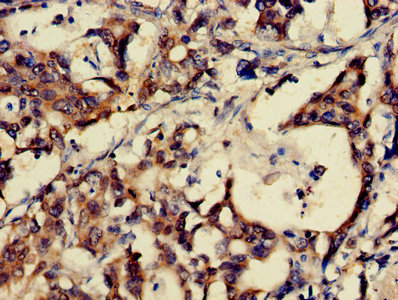
The antibody against GRP was raised in rabbit using the Recombinant Human Gastrin-releasing peptide protein (31-98AA) as the immunogen. This antibody exists as a non-conjugated isotype IgG, purified by protein G with a purity greater than 95%. This antibody has been validated on ELISA, IHC.
$299.00
| Cat.No | ADC-44911A | Clonality | Polyclonal |
|---|---|---|---|
| Host Species | Rabbit | Target Name | GRP |
| Form | Liquid | Species Reactivity | Human |
| Isotype | IgG | Storage Buffer | 0.01M PBS, 0.03% Proclin 300; Constituents: 50% Glycerol, PH 7.4 |
| Purification Method | >95%, Protein G purified | Conjugate | Non-conjugated |
| Application | ELISA, IHC | Storage | Upon receipt |
| Immunogen Description | Recombinant Human Gastrin-releasing peptide protein (31-98AA) | Target Species | Human |
|---|---|---|---|
| Immunogen Sequence | Complete sequences for the immunogen, target protein, and peptides are available upon request. | Uniprot ID | P07492 |
Uniprot Id
P07492
Target Species
Human
Target Name
GRP
Target Full Name
Gastrin-releasing peptide
Target Function
Stimulates the release of gastrin and other gastrointestinal hormones. Contributes to the perception of prurient stimuli and to the transmission of itch signals in the spinal cord that promote scratching behavior. Contributes primarily to nonhistaminergic itch sensation. Contributes to long-term fear memory, but not normal spatial memory. Contributes to the regulation of food intake.
Target Subcellular Location
Secreted. Cytoplasmic vesicle, secretory vesicle lumen.
Target Protein Families
Bombesin/neuromedin-B/ranatensin family
Target Research Area
Signal Transduction
Target Synonyms
BN; Bombesin; GRP; GRP-10; GRP_HUMAN; GRP10; Neuromedin-C; NeuromedinC; Pre progastrin releasing peptide; PreproGRP; ProGRP
Target Background
This gene encodes a member of the bombesin-like family of gastrin-releasing peptides. The encoded preproprotein is proteolytically processed to generate two peptides, gastrin-releasing peptide and neuromedin-C. These peptides regulate numerous functions of the gastrointestinal and central nervous systems, including release of gastrointestinal hormones, smooth muscle cell contraction, and epithelial cell proliferation. These peptides are also likely to play a role in human cancers of the lung, colon, stomach, pancreas, breast, and prostate. Alternative splicing results in multiple transcript variants, at least one of which encodes a preproprotein that is proteolytically processed.
Notification