• Contact info@abtriva.com for inquiries and orders.
  • Chinese (Simplified)

  • English

  • German

  • Korean

  • Spanish

United States (English / $ USD)

Rabbit anti-Human ABCD4 Polyclonal Antibody

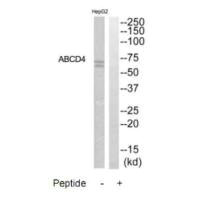
The antibody against ABCD4 was raised in rabbit using the Synthesized peptide derived from internal of Human ABCD4. as the immunogen. The antibody was affinity-purified from rabbit antiserum by affinity-chromatography using epitope-specific immunogen. This antibody has been validated on ELISA, WB.

ADC-41447A

The antibody against ABCD4 was raised in rabbit using the Synthesized peptide derived from internal of Human ABCD4. as the immunogen. The antibody was affinity-purified from rabbit antiserum by affinity-chromatography using epitope-specific immunogen. This antibody has been validated on ELISA, WB.

$297.00

Number
Order Exclusive Products Now

Request a Quote
High Purity LevelsPrecision and ReliabilityCustomization Options

Specifications


Cat.No ADC-41447A ClonalityPolyclonal
Host SpeciesRabbitTarget NameABCD4
FormLiquidSpecies ReactivityHuman
Storage BufferPH 7.4, 0.02% sodium azide and 50% glycerol., 150mM NaCl, Rabbit IgG in phosphate buffered saline (without Mg2+ and Ca2+)Purification MethodThe antibody was affinity-purified from rabbit antiserum by affinity-chromatography using epitope-specific immunogen.
ApplicationELISA, WBStorageUpon receipt

Immunogen Information


Immunogen DescriptionSynthesized peptide derived from internal of Human ABCD4.Target SpeciesHuman
Immunogen SequenceComplete sequences for the immunogen, target protein, and peptides are available upon request.Uniprot IDO14678
Background Information
  • Uniprot Id

    O14678

  • Target Species

    Human

  • Target Name

    ABCD4

  • Target Full Name

    Lysosomal cobalamin transporter ABCD4

  • Target Function

    Lysosomal membrane protein that transports cobalamin (Vitamin B12) from the lysosomal lumen to the cytosol in an ATP-dependent manner. Targeted by LMBRD1 lysosomal chaperone from the endoplasmic reticulum to the lysosomal membrane. Then forms a complex with lysosomal chaperone LMBRD1 and cytosolic MMACHC to transport cobalamin across the lysosomal membrane.

  • Target Involvement

    Methylmalonic aciduria and homocystinuria type cblJ (MAHCJ)

  • Target Subcellular Location

    Endoplasmic reticulum membrane; Multi-pass membrane protein. Lysosome membrane; Multi-pass membrane protein.

  • Target Protein Families

    ABC transporter superfamily, ABCD family, Peroxisomal fatty acyl CoA transporter (TC 3.A.1.203) subfamily

  • Target Tissue Specificity

    Ubiquitous.

  • Target Synonyms

    ABCD4; PXMP1L; Lysosomal cobalamin transporter ABCD4; ATP-binding cassette sub-family D member 4; PMP70-related protein; P70R; Peroxisomal membrane protein 1-like; PXMP1-L; Peroxisomal membrane protein 69; PMP69

  • Target Background

    The protein encoded by this gene is a member of the superfamily of ATP-binding cassette (ABC) transporters. ABC proteins transport various molecules across extra- and intra-cellular membranes. ABC genes are divided into seven distinct subfamilies (ABC1, MDR/TAP, MRP, ALD, OABP, GCN20, White). This protein is a member of the ALD subfamily, which is involved in peroxisomal import of fatty acids and/or fatty acyl-CoAs in the organelle. All known peroxisomal ABC transporters are half transporters which require a partner half transporter molecule to form a functional homodimeric or heterodimeric transporter. The function of this peroxisomal membrane protein is unknown. However, it is speculated that it may function as a heterodimer for another peroxisomal ABC transporter and, therefore, may modify the adrenoleukodystrophy phenotype. It may also play a role in the process of peroxisome biogenesis. Alternative splicing results in several protein-coding and non-protein-coding variants.

Inquire Rabbit anti-Human ABCD4 Polyclonal Antibody Now


AbTriva respects your privacy and protects your personal data in accordance with AbTriva. For more information, please see our data protection statement. *

Notification