• Contact info@abtriva.com for inquiries and orders.
  • Chinese (Simplified)

  • English

  • German

  • Korean

  • Spanish

United States (English / $ USD)

Rabbit anti-Human AURKC Polyclonal Antibody

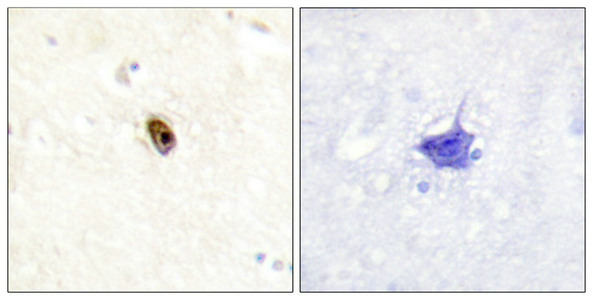
The antibody against AURKC was raised in rabbit using the Peptide sequence around phosphorylation site of threonine 236/202 (C-G-T(p)-L-D) derived from Human AurB/C. as the immunogen. Antibodies were produced by immunizing rabbits with synthetic phosphopeptide and KLH conjugates. Antibodies were purified by affinity-chromatography using epitope-specific phosphopeptide. Non-phospho specific antibodies were removed by chromatogramphy usi This antibody has been validated on ELISA, IHC.

ADC-40602A

The antibody against AURKC was raised in rabbit using the Peptide sequence around phosphorylation site of threonine 236/202 (C-G-T(p)-L-D) derived from Human AurB/C. as the immunogen. Antibodies were produced by immunizing rabbits with synthetic phosphopeptide and KLH conjugates. Antibodies were purified by affinity-chromatography using epitope-specific phosphopeptide. Non-phospho specific antibodies were removed by chromatogramphy usi This antibody has been validated on ELISA, IHC.

$360.00

Number
Order Exclusive Products Now

Request a Quote
High Purity LevelsPrecision and ReliabilityCustomization Options

Specifications


Cat.No ADC-40602A ClonalityPolyclonal
Host SpeciesRabbitTarget NameAURKC
FormLiquidSpecies ReactivityHuman, Mouse, Rat
Storage BufferPH 7.4, 0.02% sodium azide and 50% glycerol., 150mM NaCl, Rabbit IgG in phosphate buffered saline (without Mg2+ and Ca2+)ApplicationELISA, IHC
StorageUpon receipt

Immunogen Information


Immunogen DescriptionPeptide sequence around phosphorylation site of threonine 236/202 (C-G-T(p)-L-D) derived from Human AurB/C.Target SpeciesHuman
Immunogen SequenceComplete sequences for the immunogen, target protein, and peptides are available upon request.Uniprot IDQ9UQB9
Background Information
  • Uniprot Id

    Q9UQB9

  • Target Species

    Human

  • Target Name

    AURKC

  • Target Full Name

    Aurora kinase C

  • Target Function

    Serine/threonine-protein kinase component of the chromosomal passenger complex (CPC), a complex that acts as a key regulator of mitosis. The CPC complex has essential functions at the centromere in ensuring correct chromosome alignment and segregation and is required for chromatin-induced microtubule stabilization and spindle assembly. Plays also a role in meiosis and more particularly in spermatogenesis. Has redundant cellular functions with AURKB and can rescue an AURKB knockdown. Like AURKB, AURKC phosphorylates histone H3 at 'Ser-10' and 'Ser-28'. AURKC phosphorylates the CPC complex subunits BIRC5/survivin and INCENP leading to increased AURKC activity. Phosphorylates TACC1, another protein involved in cell division, at 'Ser-228'.

  • Target Involvement

    Spermatogenic failure 5 (SPGF5)

  • Target Subcellular Location

    Nucleus. Chromosome. Chromosome, centromere. Cytoplasm, cytoskeleton, spindle.

  • Target Protein Families

    Protein kinase superfamily, Ser/Thr protein kinase family, Aurora subfamily

  • Target Tissue Specificity

    Isoform 1 and isoform 2 are expressed in testis. Elevated expression levels were seen only in a subset of cancer cell lines such as Hep-G2, Huh-7 and HeLa. Expression is maximum at M phase.

  • Target Synonyms

    AURKC; AIE 2; Aie1; AIE2; AIK 3; AIK3; ARK 3; ARK-3; ARK3; Aur C; AurC; Aurkc; AURKC_HUMAN; aurora 3; Aurora C; Aurora kinase C; aurora related kinase 3; Aurora-related kinase 3; Aurora/Ipl1 related kinase 3; Aurora/Ipl1-related kinase 3; Aurora/Ipl1/Eg2 protein 2; EC 2.7.11.1; Serine threonine protein kinase 13; serine/threonine kinase 13 (aurora/IPL1 like); serine/threonine protein kinase aurora C; Serine/threonine-protein kinase 13; Serine/threonine-protein kinase aurora-C; SPGF5; STK13

  • Target Background

    This gene encodes a member of the Aurora subfamily of serine/threonine protein kinases. The encoded protein is a chromosomal passenger protein that forms complexes with Aurora-B and inner centromere proteins and may play a role in organizing microtubules in relation to centrosome/spindle function during mitosis. This gene is overexpressed in several cancer cell lines, suggesting an involvement in oncogenic signal transduction. Alternative splicing results in multiple transcript variants.

Inquire Rabbit anti-Human AURKC Polyclonal Antibody Now


AbTriva respects your privacy and protects your personal data in accordance with AbTriva. For more information, please see our data protection statement. *

Notification