-
Chinese (Simplified)
-
English
-
German
-
Korean
-
Spanish
Chinese (Simplified)
English
German
Korean
Spanish
Sign up for an account to enjoy easy online shopping and instant order tracking.
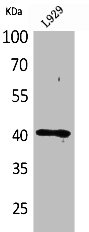
The antibody against CCR3 was raised in rabbit using the Synthesized peptide derived from the N-terminal region of Human CKR-3. as the immunogen. This antibody exists as a non-conjugated isotype IgG. The antibody was affinity-purified from rabbit antiserum by affinity-chromatography using epitope-specific immunogen. This antibody has been validated on WB, ELISA.
$167.00
| Cat.No | ADC-37064A | Clonality | Polyclonal |
|---|---|---|---|
| Host Species | Rabbit | Target Name | CCR3 |
| Target Synonyms | CCR3; CMKBR3; C-C chemokine receptor type 3; C C CKR3; C-C CKR-3; CC-CKR-3; CCR-3; CCR3; CKR 3; CKR3; Eosinophil eotaxin receptor; CD antigen CD193 | Form | Liquid |
| Species Reactivity | Human | Isotype | IgG |
| Storage Buffer | 0.5% BSA and 0.02% sodium azide., Liquid in PBS containing 50% glycerol | Purification Method | The antibody was affinity-purified from rabbit antiserum by affinity-chromatography using epitope-specific immunogen. |
| Conjugate | Non-conjugated | Application | ELISA, WB |
| Storage | Upon receipt |
| Immunogen Description | Synthesized peptide derived from the N-terminal region of Human CKR-3. | Target Species | Human |
|---|---|---|---|
| Immunogen Sequence | Complete sequences for the immunogen, target protein, and peptides are available upon request. | Uniprot ID | P51677 |
Uniprot Id
P51677
Target Species
Human
Target Name
CCR3
Target Full Name
C-C chemokine receptor type 3
Target Function
Receptor for C-C type chemokine. Binds and responds to a variety of chemokines, including CCL11, CCL26, CCL7, CCL13, RANTES(CCL5) and CCL15. Subsequently transduces a signal by increasing the intracellular calcium ions level. In addition acts as a possible functional receptor for NARS1.; (Microbial infection) Alternative coreceptor with CD4 for HIV-1 infection.
Target Subcellular Location
Cell membrane; Multi-pass membrane protein.
Target Protein Families
G-protein coupled receptor 1 family
Target Tissue Specificity
In eosinophils as well as trace amounts in neutrophils and monocytes.
Target Research Area
Immunology
Target Synonyms
CCR3; CMKBR3; C-C chemokine receptor type 3; C C CKR3; C-C CKR-3; CC-CKR-3; CCR-3; CCR3; CKR 3; CKR3; Eosinophil eotaxin receptor; CD antigen CD193
Target Background
The protein encoded by this gene is a receptor for C-C type chemokines. It belongs to family 1 of the G protein-coupled receptors. This receptor binds and responds to a variety of chemokines, including eotaxin (CCL11), eotaxin-3 (CCL26), MCP-3 (CCL7), MCP-4 (CCL13), and RANTES (CCL5). It is highly expressed in eosinophils and basophils, and is also detected in TH1 and TH2 cells, as well as in airway epithelial cells. This receptor may contribute to the accumulation and activation of eosinophils and other inflammatory cells in the allergic airway. It is also known to be an entry co-receptor for HIV-1. This gene and seven other chemokine receptor genes form a chemokine receptor gene cluster on the chromosomal region 3p21. Alternatively spliced transcript variants have been described.
Notification