-
Chinese (Simplified)
-
English
-
German
-
Korean
-
Spanish
Chinese (Simplified)
English
German
Korean
Spanish
Sign up for an account to enjoy easy online shopping and instant order tracking.
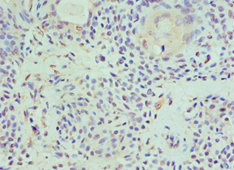
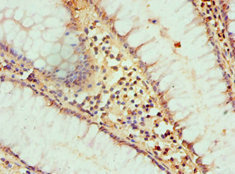
The antibody against HAT1 was raised in rabbit using the Recombinant Human Histone acetyltransferase type B catalytic subunit protein (245-419AA) as the immunogen. This antibody exists as a non-conjugated isotype IgG, Antigen affinity purified. This antibody has been validated on ELISA, WB, IHC.
$299.00
| Cat.No | ADC-45303A | Clonality | Polyclonal |
|---|---|---|---|
| Host Species | Rabbit | Target Name | HAT1 |
| Form | Liquid | Species Reactivity | Human |
| Isotype | IgG | Storage Buffer | 50% Glycerol, PBS with 0.02% sodium azide, pH7.3. |
| Purification Method | Antigen affinity purified | Conjugate | Non-conjugated |
| Application | ELISA, IHC, WB | Storage | Upon receipt |
| Immunogen Description | Recombinant Human Histone acetyltransferase type B catalytic subunit protein (245-419AA) | Target Species | Human |
|---|---|---|---|
| Immunogen Sequence | Complete sequences for the immunogen, target protein, and peptides are available upon request. | Uniprot ID | O14929 |
Uniprot Id
O14929
Target Species
Human
Target Name
HAT1
Target Full Name
Histone acetyltransferase type B catalytic subunit
Target Function
Histone acetyltransferase that plays a role in different biological processes including cell cycle progression, glucose metabolism, histone production or DNA damage repair. Coordinates histone production and acetylation via H4 promoter binding. Acetylates histone H4 at 'Lys-5' (H4K5ac) and 'Lys-12' (H4K12ac) and, to a lesser extent, histone H2A at 'Lys-5' (H2AK5ac). Drives H4 production by chromatin binding to support chromatin replication and acetylation. Since transcription of H4 genes is tightly coupled to S-phase, plays an important role in S-phase entry and progression. Promotes homologous recombination in DNA repair by facilitating histone turnover and incorporation of acetylated H3.3 at sites of double-strand breaks. In addition, acetylates other substrates such as chromatin-related proteins. Acetylates also RSAD2 which mediates the interaction of ubiquitin ligase UBE4A with RSAD2 leading to RSAD2 ubiquitination and subsequent degradation.; (Microbial infection) Contributes to hepatitis B virus (HBV) replication by acetylating histone H4 at the sites of 'Lys-5' and 'Lys-12' on the covalently closed circular DNA (cccDNA) minichromosome leading to its accumulation within the host cell.
Target Subcellular Location
[Isoform A]: Nucleus matrix. Mitochondrion.; [Isoform B]: Cytoplasm. Nucleus. Nucleus matrix. Nucleus, nucleoplasm.
Target Protein Families
HAT1 family
Target Synonyms
HAT 1; hat1; HAT1_HUMAN; Histidine aminotransferase 1; Histone acetyltransferase 1 ; Histone acetyltransferase 1; Histone acetyltransferase type B catalytic subunit; KAT1
Target Background
The protein encoded by this gene is a type B histone acetyltransferase (HAT) that is involved in the rapid acetylation of newly synthesized cytoplasmic histones, which are in turn imported into the nucleus for de novo deposition onto nascent DNA chains. Histone acetylation, particularly of histone H4, plays an important role in replication-dependent chromatin assembly. Specifically, this HAT can acetylate soluble but not nucleosomal histone H4 at lysines 5 and 12, and to a lesser degree, histone H2A at lysine 5. Alternatively spliced transcript variants have been identified for this gene.
Notification