• Contact info@abtriva.com for inquiries and orders.
  • Chinese (Simplified)

  • English

  • German

  • Korean

  • Spanish

United States (English / $ USD)

Rabbit anti-Human INPP5D Polyclonal Antibody

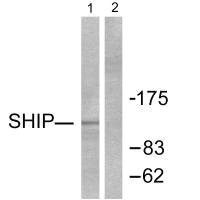
The antibody against INPP5D was raised in rabbit using the Synthesized peptide derived from Human SHIP. as the immunogen. The antibody was affinity-purified from rabbit antiserum by affinity-chromatography using epitope-specific immunogen. This antibody has been validated on ELISA, WB.

ADC-42320A

The antibody against INPP5D was raised in rabbit using the Synthesized peptide derived from Human SHIP. as the immunogen. The antibody was affinity-purified from rabbit antiserum by affinity-chromatography using epitope-specific immunogen. This antibody has been validated on ELISA, WB.

$297.00

Number
Order Exclusive Products Now

Request a Quote
High Purity LevelsPrecision and ReliabilityCustomization Options

Specifications


Cat.No ADC-42320A ClonalityPolyclonal
Host SpeciesRabbitTarget NameINPP5D
Target Synonyms4FormLiquid
Species ReactivityHuman, Mouse, RatStorage BufferPH 7.4, 0.02% sodium azide and 50% glycerol., 150mM NaCl, Rabbit IgG in phosphate buffered saline (without Mg2+ and Ca2+)
Purification MethodThe antibody was affinity-purified from rabbit antiserum by affinity-chromatography using epitope-specific immunogen.ApplicationELISA, WB
StorageUpon receipt

Immunogen Information


Immunogen DescriptionSynthesized peptide derived from Human SHIP.Target SpeciesHuman
Immunogen SequenceComplete sequences for the immunogen, target protein, and peptides are available upon request.Uniprot IDQ92835
Background Information
  • Uniprot Id

    Q92835

  • Target Species

    Human

  • Target Name

    INPP5D

  • Target Full Name

    Phosphatidylinositol 3,4,5-trisphosphate 5-phosphatase 1

  • Target Function

    Phosphatidylinositol (PtdIns) phosphatase that specifically hydrolyzes the 5-phosphate of phosphatidylinositol-3,4,5-trisphosphate (PtdIns(3,4,5)P3) to produce PtdIns(3,4)P2, thereby negatively regulating the PI3K (phosphoinositide 3-kinase) pathways. Able also to hydrolyzes the 5-phosphate of phosphatidylinositol-4,5-bisphosphate (PtdIns(4,5)P3) and inositol 1,3,4,5-tetrakisphosphate. Acts as a negative regulator of B-cell antigen receptor signaling. Mediates signaling from the FC-gamma-RIIB receptor (FCGR2B), playing a central role in terminating signal transduction from activating immune/hematopoietic cell receptor systems. Acts as a negative regulator of myeloid cell proliferation/survival and chemotaxis, mast cell degranulation, immune cells homeostasis, integrin alpha-IIb/beta-3 signaling in platelets and JNK signaling in B-cells. Regulates proliferation of osteoclast precursors, macrophage programming, phagocytosis and activation and is required for endotoxin tolerance. Involved in the control of cell-cell junctions, CD32a signaling in neutrophils and modulation of EGF-induced phospholipase C activity. Key regulator of neutrophil migration, by governing the formation of the leading edge and polarization required for chemotaxis. Modulates FCGR3/CD16-mediated cytotoxicity in NK cells. Mediates the activin/TGF-beta-induced apoptosis through its Smad-dependent expression.

  • Target Subcellular Location

    Cytoplasm. Cell membrane; Peripheral membrane protein. Membrane raft. Cytoplasm, cytoskeleton. Membrane; Peripheral membrane protein.

  • Target Protein Families

    Inositol 1,4,5-trisphosphate 5-phosphatase family

  • Target Tissue Specificity

    Specifically expressed in immune and hematopoietic cells. Expressed in bone marrow and blood cells. Levels vary considerably within this compartment. Present in at least 74% of immature CD34+ cells, whereas within the more mature population of CD33+ cells

  • Target Synonyms

    Inositol polyphosphate 5 phosphatase of 145kDa; 4; 5-trisphosphate 5-phosphatase 1; hp51CN; Inositol polyphosphate 5 phosphatase 145kDa; Inositol polyphosphate 5 phosphatase; Inositol polyphosphate-5-phosphatase of 145 kDa; INPP5D; MGC104855; MGC142140; MGC142142; p150Ship; Phosphatidylinositol 3,4,5 trisphosphate 5 phosphatase 1; Phosphatidylinositol-3; SH2 containing inositol phosphatase isoform b; SH2 domain containing inositol 5' phosphatase 1; SH2 domain containing inositol phosphatase 1; SH2 domain-containing inositol phosphatase 1; SH2 domain-containing inositol-5''-phosphatase 1; SHIP; SHIP-1; SHIP1; SHIP1_HUMAN; Signaling inositol polyphosphate 5 phosphatase SIP 145; SIP-145; SIP145

  • Target Background

    This gene is a member of the inositol polyphosphate-5-phosphatase (INPP5) family and encodes a protein with an N-terminal SH2 domain, an inositol phosphatase domain, and two C-terminal protein interaction domains. Expression of this protein is restricted to hematopoietic cells where its movement from the cytosol to the plasma membrane is mediated by tyrosine phosphorylation. At the plasma membrane, the protein hydrolyzes the 5' phosphate from phosphatidylinositol (3, 4, 5)-trisphosphate and inositol-1, 3, 4, 5-tetrakisphosphate, thereby affecting multiple signaling pathways. The protein is also partly localized to the nucleus, where it may be involved in nuclear inositol phosphate signaling processes. Overall, the protein functions as a negative regulator of myeloid cell proliferation and survival. Mutations in this gene are associated with defects and cancers of the immune system. Deficiencies in the encoded protein, SHIP1, have been associated with Inflammatory Bowel Disease types such as Crohn's Disease and Ulcerative Colitis. Alternative splicing of this gene results in multiple transcript variants.

Inquire Rabbit anti-Human INPP5D Polyclonal Antibody Now


AbTriva respects your privacy and protects your personal data in accordance with AbTriva. For more information, please see our data protection statement. *

Notification