-
Chinese (Simplified)
-
English
-
German
-
Korean
-
Spanish
Chinese (Simplified)
English
German
Korean
Spanish
Sign up for an account to enjoy easy online shopping and instant order tracking.
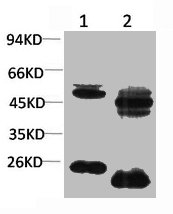
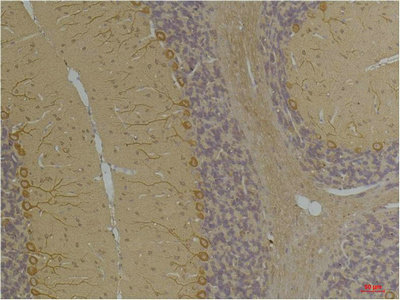
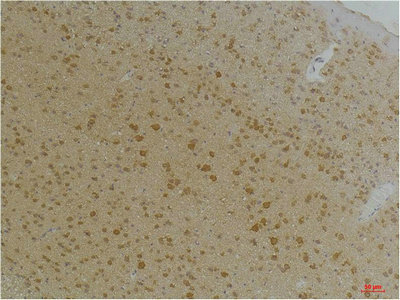
The antibody against KCNA10 was raised in rabbit using the Synthetic Peptide as the immunogen. This antibody exists as a non-conjugated antibody. The antibody was affinity-purified from rabbit antiserum by affinity-chromatography using specific immunogen. This antibody has been validated on WB, IHC, ELISA.
$167.00
| Cat.No | ADC-13172A | Clonality | Polyclonal |
|---|---|---|---|
| Host Species | Rabbit | Target Name | KCNA10 |
| Target Synonyms | KCNA10; Potassium voltage-gated channel subfamily A member 10; Voltage-gated potassium channel subunit Kv1.8 | Form | Liquid |
| Species Reactivity | Human, Mouse, Rat | Storage Buffer | 0.5% BSA and 0.02% sodium azide., Liquid in PBS containing 50% glycerol |
| Purification Method | The antibody was affinity-purified from rabbit antiserum by affinity-chromatography using specific immunogen. | Conjugate | Non-conjugated |
| Application | ELISA, IHC, WB | Storage | Upon receipt |
| Immunogen Description | Synthetic Peptide | Target Species | Human |
|---|---|---|---|
| Immunogen Sequence | Complete sequences for the immunogen, target protein, and peptides are available upon request. | Uniprot ID | Q16322 |
Uniprot Id
Q16322
Target Species
Human
Target Name
KCNA10
Target Full Name
Potassium voltage-gated channel subfamily A member 10
Target Function
Mediates voltage-dependent potassium ion permeability of excitable membranes. Assuming opened or closed conformations in response to the voltage difference across the membrane, the protein forms a potassium-selective channel through which potassium ions may pass in accordance with their electrochemical gradient. The channel activity is up-regulated by cAMP.
Target Subcellular Location
Membrane; Multi-pass membrane protein.
Target Protein Families
Potassium channel family, A (Shaker) (TC 1.A.1.2) subfamily, Kv1.8/KCNA10 sub-subfamily
Target Tissue Specificity
Detected in kidney, in proximal tubules, glomerular endothelium, in vascular endothelium and in smooth muscle cells.
Target Synonyms
KCNA10; Potassium voltage-gated channel subfamily A member 10; Voltage-gated potassium channel subunit Kv1.8
Target Background
Potassium channels represent the most complex class of voltage-gated ion channels from both functional and structural standpoints. Their diverse functions include regulating neurotransmitter release, heart rate, insulin secretion, neuronal excitability, epithelial electrolyte transport, smooth muscle contraction, and cell volume. Four sequence-related potassium channel genes - shaker, shaw, shab, and shal - have been identified in Drosophila, and each has been shown to have human homolog(s). This gene encodes a member of the potassium channel, voltage-gated, shaker-related subfamily. This member contains six membrane-spanning domains with a shaker-type repeat in the fourth segment. It is specifically regulated by cGMP and postulated to mediate the effects of substances that increase intracellular cGMP. This gene is intronless, and the gene is clustered with genes KCNA2 and KCNA3 on chromosome 1.
Notification