• Contact info@abtriva.com for inquiries and orders.
  • Chinese (Simplified)

  • English

  • German

  • Korean

  • Spanish

United States (English / $ USD)

Rabbit anti-Human KDM8 Polyclonal Antibody

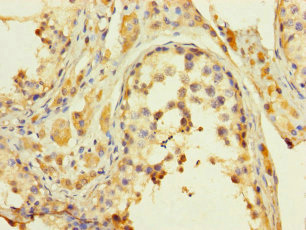
The antibody against KDM8 was raised in rabbit using the Recombinant Human JmjC domain-containing protein 5 protein (151-380AA) as the immunogen. This antibody exists as a non-conjugated isotype IgG, purified by protein G with a purity greater than 95%. This antibody has been validated on ELISA, IHC.

ADC-24641A

The antibody against KDM8 was raised in rabbit using the Recombinant Human JmjC domain-containing protein 5 protein (151-380AA) as the immunogen. This antibody exists as a non-conjugated isotype IgG, purified by protein G with a purity greater than 95%. This antibody has been validated on ELISA, IHC.

$299.00

Number
Order Exclusive Products Now

Request a Quote
High Purity LevelsPrecision and ReliabilityCustomization Options

Specifications


Cat.No ADC-24641A ClonalityPolyclonal
Host SpeciesRabbitTarget NameKDM8
FormLiquidSpecies ReactivityHuman
IsotypeIgGStorage Buffer0.01M PBS, 0.03% Proclin 300; Constituents: 50% Glycerol, PH 7.4
Purification Method>95%, Protein G purifiedConjugateNon-conjugated
ApplicationELISA, IHCStorageUpon receipt

Immunogen Information


Immunogen DescriptionRecombinant Human JmjC domain-containing protein 5 protein (151-380AA)Target SpeciesHuman
Immunogen SequenceComplete sequences for the immunogen, target protein, and peptides are available upon request.Uniprot IDQ8N371
Background Information
  • Uniprot Id

    Q8N371

  • Target Species

    Human

  • Target Name

    KDM8

  • Target Full Name

    Bifunctional peptidase and arginyl-hydroxylase JMJD5

  • Target Function

    Bifunctional enzyme that acts both as an endopeptidase and 2-oxoglutarate-dependent monoxygenase. Endopeptidase that cleaves histones N-terminal tails at the carboxyl side of methylated arginine or lysine residues, to generate 'tailless nucleosomes', which may trigger transcription elongation. Preferentially recognizes and cleaves monomethylated and dimethylated arginine residues of histones H2, H3 and H4. After initial cleavage, continues to digest histones tails via its aminopeptidase activity. Upon DNA damage, cleaves the N-terminal tail of histone H3 at monomethylated lysine residues, preferably at monomethylated 'Lys-9' (H3K9me1). The histone variant H3F3A is the major target for cleavage. Additionnally, acts as Fe(2+) and 2-oxoglutarate-dependent monoxygenase, catalyzing (R)-stereospecific hydroxylation at C-3 of 'Arg-137' of RPS6 and 'Arg-141' of RCCD1, but the biological significance of this activity remains to be established. Regulates mitosis through different mechanisms: Plays a role in transcriptional repression of satellite repeats, possibly by regulating H3K36 methylation levels in centromeric regions together with RCCD1. Possibly together with RCCD1, is involved in proper mitotic spindle organization and chromosome segregation. Negatively regulates cell cycle repressor CDKN1A/p21, which controls G1/S phase transition. Required for G2/M phase cell cycle progression. Regulates expression of CCNA1/cyclin-A1, leading to cancer cell proliferation. Also, plays a role in regulating alpha-tubulin acetylation and cytoskeletal microtubule stability involved in epithelial to mesenchymal transition. Regulates the circadian gene expression in the liver. Represses the transcriptional activator activity of the CLOCK-ARNTL/BMAL1 heterodimer in a catalytically-independent manner. Negatively regulates the protein stability and function of CRY1; required for AMPK-FBXL3-induced CRY1 degradation.

  • Target Subcellular Location

    Nucleus. Chromosome.

  • Target Tissue Specificity

    Weakly expressed in most cells. Highly expressed in breast cancer cells. Expressed in embryonic stem cells.

  • Target Synonyms

    FLJ13798; JmjC domain-containing protein 5; JMJD5; JMJD5 protein; jumonji domain containing 5; Jumonji domain-containing protein 5; KDM8_HUMAN; Lysine (K) specific demethylase 8; Lysine-specific demethylase 8

  • Target Background

    This gene likely encodes a histone lysine demethylase. Studies of a similar protein in mouse indicate a potential role for this protein as a tumor suppressor. Alternatively spliced transcript variants have been described.

Inquire Rabbit anti-Human KDM8 Polyclonal Antibody Now


AbTriva respects your privacy and protects your personal data in accordance with AbTriva. For more information, please see our data protection statement. *

Notification