-
Chinese (Simplified)
-
English
-
German
-
Korean
-
Spanish
Chinese (Simplified)
English
German
Korean
Spanish
Sign up for an account to enjoy easy online shopping and instant order tracking.
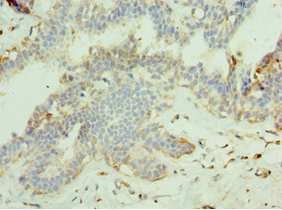
The antibody against MAPK15 was raised in rabbit using the Recombinant Human Mitogen-activated protein kinase 15 protein (1-95AA) as the immunogen. This antibody exists as a non-conjugated isotype IgG, Antigen affinity purified. This antibody has been validated on ELISA, WB, IHC.
$299.00
| Cat.No | ADC-40217A | Clonality | Polyclonal |
|---|---|---|---|
| Host Species | Rabbit | Target Name | MAPK15 |
| Form | Liquid | Species Reactivity | Human |
| Isotype | IgG | Storage Buffer | 50% Glycerol, PBS with 0.02% sodium azide, pH7.3. |
| Purification Method | Antigen affinity purified | Conjugate | Non-conjugated |
| Application | ELISA, IHC, WB | Storage | Upon receipt |
| Immunogen Description | Recombinant Human Mitogen-activated protein kinase 15 protein (1-95AA) | Target Species | Human |
|---|---|---|---|
| Immunogen Sequence | Complete sequences for the immunogen, target protein, and peptides are available upon request. | Uniprot ID | Q8TD08 |
Uniprot Id
Q8TD08
Target Species
Human
Target Name
MAPK15
Target Full Name
Mitogen-activated protein kinase 15
Target Function
Atypical MAPK protein that regulates several process such as autophagy, ciliogenesis, protein trafficking/secretion and genome integrity, in a kinase activity-dependent manner. Controls both, basal and starvation-induced autophagy throught its interaction with GABARAP, MAP1LC3B and GABARAPL1 leading to autophagosome formation, SQSTM1 degradation and reduced MAP1LC3B inhibitory phosphorylation. Regulates primary cilium formation and the localization of ciliary proteins involved in cilium structure, transport, and signaling. Prevents the relocation of the sugar-adding enzymes from the Golgi to the endoplasmic reticulum, thereby restricting the production of sugar-coated proteins. Upon amino-acid starvation, mediates transitional endoplasmic reticulum site disassembly and inhibition of secretion. Binds to chromatin leading to MAPK15 activation and interaction with PCNA, that which protects genomic integrity by inhibiting MDM2-mediated degradation of PCNA. Regulates DA transporter (DAT) activity and protein expression via activation of RhoA. In response to H(2)O(2) treatment phosphorylates ELAVL1, thus preventing it from binding to the PDCD4 3'UTR and rendering the PDCD4 mRNA accessible to miR-21 and leading to its degradation and loss of protein expression. Also functions in a kinase activity-independent manner as a negative regulator of growth. Phosphorylates in vitro FOS and MBP. During oocyte maturation, plays a key role in the microtubule organization and meiotic cell cycle progression in oocytes, fertilized eggs, and early embryos. Interacts with ESRRA promoting its re-localization from the nucleus to the cytoplasm and then prevents its transcriptional activity.
Target Subcellular Location
Cytoplasm, cytoskeleton, cilium basal body. Cell junction, tight junction. Cytoplasm, cytoskeleton, microtubule organizing center, centrosome, centriole. Cytoplasmic vesicle, autophagosome. Golgi apparatus. Nucleus. Cytoplasm. Cytoplasm, cytoskeleton, spindle.
Target Protein Families
Protein kinase superfamily, CMGC Ser/Thr protein kinase family, MAP kinase subfamily
Target Tissue Specificity
Widely expressed with a maximal expression in lung and kidney.
Target Synonyms
ERK-7; ERK-8; ERK7 ; ERK8; Extracellular regulated kinase 8 delta ; Extracellular signal regulated kinase 8; Extracellular signal-regulated kinase 7; Extracellular signal-regulated kinase 8; MAP kinase 15; MAPK 15; Mapk15; Mitogen activated protein kinase 15 ; Mitogen-activated protein kinase 15; MK15_HUMAN
Notification