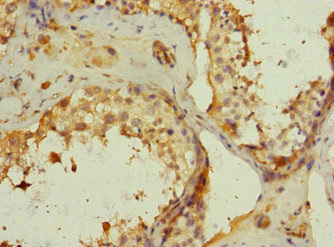
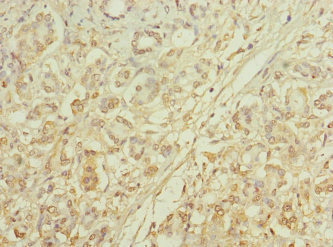
-
Chinese (Simplified)
-
English
-
German
-
Korean
-
Spanish

Chinese (Simplified)
English
German
Korean
Spanish
Sign up for an account to enjoy easy online shopping and instant order tracking.
The antibody against MRC2 was raised in rabbit using the Recombinant Human C-type mannose receptor 2 protein (120-300AA) as the immunogen. This antibody exists as a non-conjugated isotype IgG, Antigen affinity purified. This antibody has been validated on ELISA, IHC.
$299.00
| Cat.No | ADC-16405A | Clonality | Polyclonal |
|---|---|---|---|
| Host Species | Rabbit | Target Name | MRC2 |
| Form | Liquid | Species Reactivity | Human |
| Isotype | IgG | Storage Buffer | 50% Glycerol, PBS with 0.02% sodium azide, pH7.3. |
| Purification Method | Antigen affinity purified | Conjugate | Non-conjugated |
| Application | ELISA, IHC | Storage | Upon receipt |
| Immunogen Description | Recombinant Human C-type mannose receptor 2 protein (120-300AA) | Target Species | Human |
|---|---|---|---|
| Immunogen Sequence | Complete sequences for the immunogen, target protein, and peptides are available upon request. | Uniprot ID | Q9UBG0 |
Uniprot Id
Q9UBG0
Target Species
Human
Target Name
MRC2
Target Full Name
C-type mannose receptor 2
Target Function
May play a role as endocytotic lectin receptor displaying calcium-dependent lectin activity. Internalizes glycosylated ligands from the extracellular space for release in an endosomal compartment via clathrin-mediated endocytosis. May be involved in plasminogen activation system controlling the extracellular level of PLAUR/PLAU, and thus may regulate protease activity at the cell surface. May contribute to cellular uptake, remodeling and degradation of extracellular collagen matrices. May play a role during cancer progression as well as in other chronic tissue destructive diseases acting on collagen turnover. May participate in remodeling of extracellular matrix cooperating with the matrix metalloproteinases (MMPs).
Target Subcellular Location
Membrane; Single-pass type I membrane protein.
Target Tissue Specificity
Ubiquitous with low expression in brain, placenta, lung, kidney, pancreas, spleen, thymus and colon. Expressed in endothelial cells, fibroblasts and macrophages. Highly expressed in fetal lung and kidney.
Target Synonyms
C-type lectin domain family 13 member E; C-type mannose receptor 2; CD 280; CD280; CD280 antigen; CLEC 13E; CLEC13E; ENDO 180; ENDO180; Endocytic receptor (macrophage mannose receptor family); Endocytic receptor 180; FLJ35911; KIAA0709; Macrophage mannose receptor 2; Mannose receptor C type 2; MRC 2; MRC2; MRC2_HUMAN; UPAR-associated protein; UPARAP; Urokinase plasminogen activator receptor associated protein; Urokinase receptor associated protein; Urokinase receptor-associated protein; Urokinase-type plasminogen activator receptor-associated protein
Target Background
This gene encodes a member of the mannose receptor family of proteins that contain a fibronectin type II domain and multiple C-type lectin-like domains. The encoded protein plays a role in extracellular matrix remodeling by mediating the internalization and lysosomal degradation of collagen ligands. Expression of this gene may play a role in the tumorigenesis and metastasis of several malignancies including breast cancer, gliomas and metastatic bone disease.
Notification