• Contact info@abtriva.com for inquiries and orders.
  • Chinese (Simplified)

  • English

  • German

  • Korean

  • Spanish

United States (English / $ USD)

Rabbit anti-Human NACA Polyclonal Antibody

The antibody against NACA was raised in Rabbit using the recombinant fusion protein containing a sequence corresponding to amino acids 1-215 of human NACA (NP_001106673.1) as the immunogen. The polyclonal antibody exists as a isotype IgG, by affinity purification. This antibody has been validated on WB, ELISA.

ADA-01271A

The antibody against NACA was raised in Rabbit using the recombinant fusion protein containing a sequence corresponding to amino acids 1-215 of human NACA (NP_001106673.1) as the immunogen. The polyclonal antibody exists as a isotype IgG, by affinity purification. This antibody has been validated on WB, ELISA.

Number
Order Exclusive Products Now

Request a Quote
High Purity LevelsPrecision and ReliabilityCustomization Options

Specifications


Cat.No ADA-01271A ClonalityPolyclonal
Host SpeciesRabbitTarget NameNACA
Target SynonymsHSD48; NACA1; skNAC; NAC-alpha; NACAFormLiquid
Species ReactivityHuman, Mouse, RatIsotypeIgG
Storage Buffer50% Glycerol, PBS with 0.05% proclin300, pH7.3.Purification MethodAffinity purification
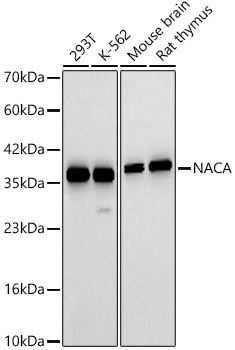
Positive Samples293T, K-562, Mouse brain, Rat thymusApplicationELISA, WB

Immunogen Information


Immunogen DescriptionRecombinant fusion protein containing a sequence corresponding to amino acids 1-215 of human NACA (NP_001106673.1).Target SpeciesHuman
Uniprot IDQ13765Immunogen Sequence
Background Information
  • Uniprot Id

    Q13765

  • Target Species

    Human

  • Target Name

    NACA

  • Target Full Name

    Nascent polypeptide-associated complex subunit alpha

  • Target Function

    Prevents inappropriate targeting of non-secretory polypeptides to the endoplasmic reticulum (ER). Binds to nascent polypeptide chains as they emerge from the ribosome and blocks their interaction with the signal recognition particle (SRP), which normally targets nascent secretory peptides to the ER. Also reduces the inherent affinity of ribosomes for protein translocation sites in the ER membrane (M sites). May act as a specific coactivator for JUN, binding to DNA and stabilizing the interaction of JUN homodimers with target gene promoters.

  • Target Subcellular Location

    Cytoplasm. Nucleus.

  • Target Protein Families

    NAC-alpha family

  • Target Tissue Specificity

    Ubiquitously expressed.

  • Target Research Area

    Epigenetics and Nuclear Signaling

  • Target Synonyms

    Alpha NAC; Alpha-NAC; Hom s 2.02; HSD48 ; MGC117224; NAC-alpha; naca; NACA/1.9.2; NACA_HUMAN; NACA1; Nascent polypeptide associated complex alpha polypeptide; Nascent polypeptide associated complex alpha subunit; Nascent polypeptide associated complex subunit alpha; Nascent polypeptide-associated complex subunit alpha

  • Target Background

    This gene encodes a protein that associates with basic transcription factor 3 (BTF3) to form the nascent polypeptide-associated complex (NAC). This complex binds to nascent proteins that lack a signal peptide motif as they emerge from the ribosome, blocking interaction with the signal recognition particle (SRP) and preventing mistranslocation to the endoplasmic reticulum. This protein is an IgE autoantigen in atopic dermatitis patients. Alternative splicing results in multiple transcript variants, but the full length nature of some of these variants, including those encoding very large proteins, has not been determined. There are multiple pseudogenes of this gene on different chromosomes.

Inquire Rabbit anti-Human NACA Polyclonal Antibody Now


AbTriva respects your privacy and protects your personal data in accordance with AbTriva. For more information, please see our data protection statement. *

Notification