• Contact info@abtriva.com for inquiries and orders.
  • Chinese (Simplified)

  • English

  • German

  • Korean

  • Spanish

United States (English / $ USD)

Rabbit anti-Human PSMD2 Polyclonal Antibody

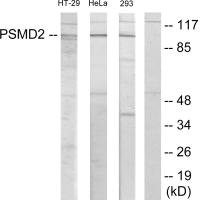
The antibody against PSMD2 was raised in rabbit using the Synthesized peptide derived from N-terminal of Human PSMD2. as the immunogen. The antibody was affinity-purified from rabbit antiserum by affinity-chromatography using epitope-specific immunogen. This antibody has been validated on ELISA, WB.

ADC-41959A

The antibody against PSMD2 was raised in rabbit using the Synthesized peptide derived from N-terminal of Human PSMD2. as the immunogen. The antibody was affinity-purified from rabbit antiserum by affinity-chromatography using epitope-specific immunogen. This antibody has been validated on ELISA, WB.

$297.00

Number
Order Exclusive Products Now

Request a Quote
High Purity LevelsPrecision and ReliabilityCustomization Options

Specifications


Cat.No ADC-41959A ClonalityPolyclonal
Host SpeciesRabbitTarget NamePSMD2
FormLiquidSpecies ReactivityHuman, Mouse, Rat
Storage BufferPH 7.4, 0.02% sodium azide and 50% glycerol., 150mM NaCl, Rabbit IgG in phosphate buffered saline (without Mg2+ and Ca2+)Purification MethodThe antibody was affinity-purified from rabbit antiserum by affinity-chromatography using epitope-specific immunogen.
ApplicationELISA, WBStorageUpon receipt

Immunogen Information


Immunogen DescriptionSynthesized peptide derived from N-terminal of Human PSMD2.Target SpeciesHuman
Immunogen SequenceComplete sequences for the immunogen, target protein, and peptides are available upon request.Uniprot IDQ13200
Background Information
  • Uniprot Id

    Q13200

  • Target Species

    Human

  • Target Name

    PSMD2

  • Target Full Name

    26S proteasome non-ATPase regulatory subunit 2

  • Target Function

    Component of the 26S proteasome, a multiprotein complex involved in the ATP-dependent degradation of ubiquitinated proteins. This complex plays a key role in the maintenance of protein homeostasis by removing misfolded or damaged proteins, which could impair cellular functions, and by removing proteins whose functions are no longer required. Therefore, the proteasome participates in numerous cellular processes, including cell cycle progression, apoptosis, or DNA damage repair.; Binds to the intracellular domain of tumor necrosis factor type 1 receptor. The binding domain of TRAP1 and TRAP2 resides outside the death domain of TNFR1.

  • Target Protein Families

    Proteasome subunit S2 family

  • Target Tissue Specificity

    Found in skeletal muscle, liver, heart, brain, kidney, pancreas, lung and placenta.

  • Target Synonyms

    26S proteasome non-ATPase regulatory subunit 2; 26S proteasome regulatory subunit RPN1; 26S proteasome regulatory subunit S2; 26S proteasome subunit p97; 55.11 protein; MGC14274; P97; Proteasome (prosome macropain) 26S subunit non ATPase 2; Proteasome 26S subunit; non-ATPase; 2; Proteasome 26S; subunit 2; Protein 55.11; Psmd2; PSMD2_HUMAN; Rpn1; S2; TNFR associated protein 2; TRAP2; Tumor necrosis factor receptor associated protein 2; Tumor necrosis factor type 1 receptor-associated protein 2

  • Target Background

    The 26S proteasome is a multicatalytic proteinase complex with a highly ordered structure composed of 2 complexes, a 20S core and a 19S regulator. The 20S core is composed of 4 rings of 28 non-identical subunits; 2 rings are composed of 7 alpha subunits and 2 rings are composed of 7 beta subunits. The 19S regulator is composed of a base, which contains 6 ATPase subunits and 2 non-ATPase subunits, and a lid, which contains up to 10 non-ATPase subunits. Proteasomes are distributed throughout eukaryotic cells at a high concentration and cleave peptides in an ATP/ubiquitin-dependent process in a non-lysosomal pathway. An essential function of a modified proteasome, the immunoproteasome, is the processing of class I MHC peptides. This gene encodes one of the non-ATPase subunits of the 19S regulator lid. In addition to participation in proteasome function, this subunit may also participate in the TNF signalling pathway since it interacts with the tumor necrosis factor type 1 receptor. A pseudogene has been identified on chromosome 1. Alternative splicing results in multiple transcript variants of this gene.

Inquire Rabbit anti-Human PSMD2 Polyclonal Antibody Now


AbTriva respects your privacy and protects your personal data in accordance with AbTriva. For more information, please see our data protection statement. *

Notification