-
Chinese (Simplified)
-
English
-
German
-
Korean
-
Spanish
Chinese (Simplified)
English
German
Korean
Spanish
Sign up for an account to enjoy easy online shopping and instant order tracking.
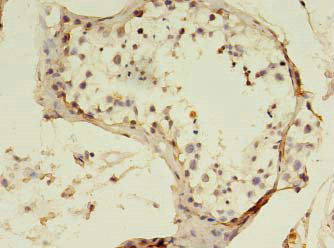
The antibody against SART3 was raised in rabbit using the Recombinant Human Squamous cell carcinoma antigen recognized by T-cells 3 protein (600-900AA) as the immunogen. This antibody exists as a non-conjugated isotype IgG, purified by protein G with a purity greater than 95%. This antibody has been validated on ELISA, IHC.
$299.00
| Cat.No | ADC-23701A | Clonality | Polyclonal |
|---|---|---|---|
| Host Species | Rabbit | Target Name | SART3 |
| Form | Liquid | Species Reactivity | Human |
| Isotype | IgG | Storage Buffer | 0.01M PBS, 0.03% Proclin 300; Constituents: 50% Glycerol, PH 7.4 |
| Purification Method | >95%, Protein G purified | Conjugate | Non-conjugated |
| Application | ELISA, IHC | Storage | Upon receipt |
| Immunogen Description | Recombinant Human Squamous cell carcinoma antigen recognized by T-cells 3 protein (600-900AA) | Target Species | Human |
|---|---|---|---|
| Immunogen Sequence | Complete sequences for the immunogen, target protein, and peptides are available upon request. | Uniprot ID | Q15020 |
Uniprot Id
Q15020
Target Species
Human
Target Name
SART3
Target Full Name
Squamous cell carcinoma antigen recognized by T-cells 3
Target Function
U6 snRNP-binding protein that functions as a recycling factor of the splicing machinery. Promotes the initial reassembly of U4 and U6 snRNPs following their ejection from the spliceosome during its maturation. Also binds U6atac snRNPs and may function as a recycling factor for U4atac/U6atac spliceosomal snRNP, an initial step in the assembly of U12-type spliceosomal complex. The U12-type spliceosomal complex plays a role in the splicing of introns with non-canonical splice sites. May also function as a substrate-targeting factor for deubiquitinases like USP4 and USP15. Recruits USP4 to ubiquitinated PRPF3 within the U4/U5/U6 tri-snRNP complex, promoting PRPF3 deubiquitination and thereby regulating the spliceosome U4/U5/U6 tri-snRNP spliceosomal complex disassembly. May also recruit the deubiquitinase USP15 to histone H2B and mediate histone deubiquitination, thereby regulating gene expression and/or DNA repair. May play a role in hematopoiesis probably through transcription regulation of specific genes including MYC.; Regulates Tat transactivation activity through direct interaction. May be a cellular factor for HIV-1 gene expression and viral replication.
Target Subcellular Location
Nucleus, nucleoplasm. Nucleus, Cajal body. Nucleus speckle. Cytoplasm.
Target Tissue Specificity
Ubiquitously expressed.
Target Research Area
Cancer
Target Synonyms
DSAP1; hSART 3; hSART-3; P100; P110; p110(nrb); RP11 13G14; SART 3; SART-3; SART3; SART3_HUMAN; Squamous cell carcinoma antigen recognized by T cells 3; Squamous cell carcinoma antigen recognized by T-cells 3; Tat interacting protein of 110 kDa; Tat-interacting protein of 110 kDa; Tip110
Target Background
The protein encoded by this gene is an RNA-binding nuclear protein that is a tumor-rejection antigen. This antigen possesses tumor epitopes capable of inducing HLA-A24-restricted and tumor-specific cytotoxic T lymphocytes in cancer patients and may be useful for specific immunotherapy. This gene product is found to be an important cellular factor for HIV-1 gene expression and viral replication. It also associates transiently with U6 and U4/U6 snRNPs during the recycling phase of the spliceosome cycle. This encoded protein is thought to be involved in the regulation of mRNA splicing.
Notification