-
Chinese (Simplified)
-
English
-
German
-
Korean
-
Spanish
Chinese (Simplified)
English
German
Korean
Spanish
Sign up for an account to enjoy easy online shopping and instant order tracking.
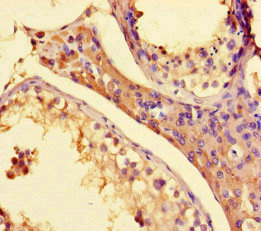
The antibody against SETD1A was raised in rabbit using the Recombinant Human Histone-lysine N-methyltransferase SETD1A protein (188-304AA) as the immunogen. This antibody exists as a non-conjugated isotype IgG, purified by protein G with a purity greater than 95%. This antibody has been validated on ELISA, IHC.
$299.00
| Cat.No | ADC-15713A | Clonality | Polyclonal |
|---|---|---|---|
| Host Species | Rabbit | Target Name | SETD1A |
| Form | Liquid | Species Reactivity | Human |
| Isotype | IgG | Storage Buffer | 0.01M PBS, 0.03% Proclin 300; Constituents: 50% Glycerol, PH 7.4 |
| Purification Method | >95%, Protein G purified | Conjugate | Non-conjugated |
| Application | ELISA, IHC | Storage | Upon receipt |
| Immunogen Description | Recombinant Human Histone-lysine N-methyltransferase SETD1A protein (188-304AA) | Target Species | Human |
|---|---|---|---|
| Immunogen Sequence | Complete sequences for the immunogen, target protein, and peptides are available upon request. | Uniprot ID | O15047 |
Uniprot Id
O15047
Target Species
Human
Target Name
SETD1A
Target Full Name
Histone-lysine N-methyltransferase SETD1A
Target Function
Histone methyltransferase that catalyzes methyl group transfer from S-adenosyl-L-methionine to the epsilon-amino group of 'Lys-4' of histone H3 (H3K4) via a non-processive mechanism. Part of chromatin remodeling machinery, forms H3K4me1, H3K4me2 and H3K4me3 methylation marks at active chromatin sites where transcription and DNA repair take place. Responsible for H3K4me3 enriched promoters and transcriptional programming of inner mass stem cells and neuron progenitors during embryogenesis. Required for H3K4me1 mark at stalled replication forks. Mediates FANCD2-dependent nucleosome remodeling and RAD51 nucleofilaments stabilization at reversed forks, protecting them from nucleolytic degradation. Does not methylate 'Lys-4' of histone H3 if the neighboring 'Lys-9' residue is already methylated.
Target Subcellular Location
Nucleus speckle. Chromosome. Note=Localizes to a largely non-overlapping set of euchromatic nuclear speckles with SETD1B, suggesting that SETD1A and SETD1B each bind to a unique set of target genes.
Target Protein Families
Class V-like SAM-binding methyltransferase superfamily
Target Synonyms
Histone-lysine N-methyltransferase SETD1A; hSET1A; KMT2F; Lysine N methyltransferase 2F; Lysine N-methyltransferase 2F; SET domain containing 1A; SET domain containing protein 1A; SET domain-containing protein 1A; SET1; Set1 Ash2 histone methyltransferase complex subunit SET1; Set1/Ash2 histone methyltransferase complex subunit SET1; SET1A; SET1A_HUMAN; SETD1A
Target Background
The protein encoded by this gene is a component of a histone methyltransferase (HMT) complex that produces mono-, di-, and trimethylated histone H3 at Lys4. Trimethylation of histone H3 at lysine 4 (H3K4me3) is a chromatin modification known to generally mark the transcription start sites of active genes. The protein contains SET domains, a RNA recognition motif domain and is a member of the class V-like SAM-binding methyltransferase superfamily.
Notification