-
Chinese (Simplified)
-
English
-
German
-
Korean
-
Spanish
Chinese (Simplified)
English
German
Korean
Spanish
Sign up for an account to enjoy easy online shopping and instant order tracking.
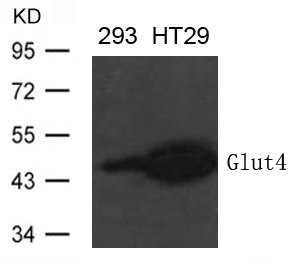
The antibody against SLC2A4 was raised in rabbit using the Peptide sequence around aa.501~ 505( E-Y-L-G-P) derived from Human Glut4. as the immunogen. Antibodies were produced by immunizing rabbits with synthetic peptide and KLH conjugates. Antibodies were purified by affinity-chromatography using epitope-specific peptide. This antibody has been validated on ELISA, WB.
$297.00
| Cat.No | ADC-43170A | Clonality | Polyclonal |
|---|---|---|---|
| Host Species | Rabbit | Target Name | SLC2A4 |
| Target Synonyms | facilitated glucose transporter member 4 antibody | Form | Liquid |
| Species Reactivity | Human, Mouse, Rat | Storage Buffer | PH 7.4, 0.02% sodium azide and 50% glycerol., 150mM NaCl, Supplied at 1.0mg/mL in phosphate buffered saline (without Mg2+ and Ca2+) |
| Purification Method | Antibodies were produced by immunizing rabbits with synthetic peptide and KLH conjugates. Antibodies were purified by affinity-chromatography using epitope-specific peptide. | Application | ELISA, WB |
| Storage | Upon receipt |
| Immunogen Description | Peptide sequence around aa.501~ 505( E-Y-L-G-P) derived from Human Glut4. | Target Species | Human |
|---|---|---|---|
| Immunogen Sequence | Complete sequences for the immunogen, target protein, and peptides are available upon request. | Uniprot ID | P14672 |
Uniprot Id
P14672
Target Species
Human
Target Name
SLC2A4
Target Full Name
Solute carrier family 2, facilitated glucose transporter member 4
Target Function
Insulin-regulated facilitative glucose transporter, which plays a key role in removal of glucose from circulation. Response to insulin is regulated by its intracellular localization: in the absence of insulin, it is efficiently retained intracellularly within storage compartments in muscle and fat cells. Upon insulin stimulation, translocates from these compartments to the cell surface where it transports glucose from the extracellular milieu into the cell.
Target Involvement
Diabetes mellitus, non-insulin-dependent (NIDDM)
Target Subcellular Location
Cell membrane; Multi-pass membrane protein. Endomembrane system; Multi-pass membrane protein. Cytoplasm, perinuclear region.
Target Protein Families
Major facilitator superfamily, Sugar transporter (TC 2.A.1.1) family, Glucose transporter subfamily
Target Tissue Specificity
Skeletal and cardiac muscles; brown and white fat.
Target Synonyms
insulin-responsive; Glucose transporter GLUT 4; Glucose transporter type 4; Glucose transporter type 4 insulin responsive; GLUT 4; GLUT-4; GLUT4; GTR4_HUMAN; Insulin responsive glucose transporter type 4; kug; SLC 2A4; SLC2A4; solute carrier family 2 (facilitated glucose transporter) member 4; Solute carrier family 2 member 4; Solute carrier family 2, facilitated glucose transporter member 4
Target Background
This gene is a member of the solute carrier family 2 (facilitated glucose transporter) family and encodes a protein that functions as an insulin-regulated facilitative glucose transporter. In the absence of insulin, this integral membrane protein is sequestered within the cells of muscle and adipose tissue. Within minutes of insulin stimulation, the protein moves to the cell surface and begins to transport glucose across the cell membrane. Mutations in this gene have been associated with noninsulin-dependent diabetes mellitus (NIDDM).
Notification