-
Chinese (Simplified)
-
English
-
German
-
Korean
-
Spanish
Chinese (Simplified)
English
German
Korean
Spanish
Sign up for an account to enjoy easy online shopping and instant order tracking.
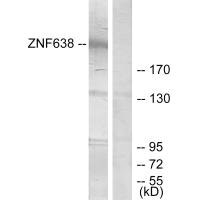
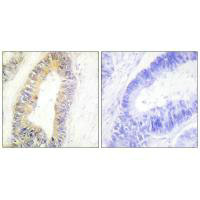
The antibody against ZNF638 was raised in rabbit using the Synthesized peptide derived from internal of Human ZNF638. as the immunogen. The antibody was affinity-purified from rabbit antiserum by affinity-chromatography using epitope-specific immunogen. This antibody has been validated on ELISA, WB, IHC.
$297.00
| Cat.No | ADC-41963A | Clonality | Polyclonal |
|---|---|---|---|
| Host Species | Rabbit | Target Name | ZNF638 |
| Form | Liquid | Species Reactivity | Human |
| Storage Buffer | PH 7.4, 0.02% sodium azide and 50% glycerol., 150mM NaCl, Rabbit IgG in phosphate buffered saline (without Mg2+ and Ca2+) | Purification Method | The antibody was affinity-purified from rabbit antiserum by affinity-chromatography using epitope-specific immunogen. |
| Application | ELISA, IHC, WB | Storage | Upon receipt |
| Immunogen Description | Synthesized peptide derived from internal of Human ZNF638. | Target Species | Human |
|---|---|---|---|
| Immunogen Sequence | Complete sequences for the immunogen, target protein, and peptides are available upon request. | Uniprot ID | Q14966 |
Uniprot Id
Q14966
Target Species
Human
Target Name
ZNF638
Target Full Name
Zinc finger protein 638
Target Function
Transcription factor that binds to cytidine clusters in double-stranded DNA. Plays a key role in the silencing of unintegrated retroviral DNA: some part of the retroviral DNA formed immediately after infection remains unintegrated in the host genome and is transcriptionally repressed. Mediates transcriptional repression of unintegrated viral DNA by specifically binding to the cytidine clusters of retroviral DNA and mediating the recruitment of chromatin silencers, such as the HUSH complex, SETDB1 and the histone deacetylases HDAC1 and HDAC4. Acts as an early regulator of adipogenesis by acting as a transcription cofactor of CEBPs (CEBPA, CEBPD and/or CEBPG), controlling the expression of PPARG and probably of other proadipogenic genes, such as SREBF1. May also regulate alternative splicing of target genes during adipogenesis.
Target Subcellular Location
Nucleus speckle.
Target Research Area
Others
Target Synonyms
CTCL tumor antigen se33 1; CTCL-associated antigen se33-1; Cutaneous T cell lymphoma associated antigen se33 1; Cutaneous T-cell lymphoma-associated antigen se33-1; DKFZp686P1231; MGC26130; MGC90196; NP220; NP220 nuclear protein; Nuclear protein 220; ZFML; Zfp638; Zinc finger matrin like; Zinc finger matrin like protein; Zinc finger matrin-like protein; Zinc finger protein 638; ZN638_HUMAN; ZNF 638; Znf638
Target Background
The protein encoded by this gene is a nucleoplasmic protein. It binds cytidine-rich sequences in double-stranded DNA. This protein has three types of domains: MH1, MH2 (repeated three times) and MH3. It is associated with packaging, transferring, or processing transcripts. Multiple alternatively spliced transcript variants have been found for this gene, but the biological validity of some variants has not been determined.
Notification