-
Chinese (Simplified)
-
English
-
German
-
Korean
-
Spanish
Chinese (Simplified)
English
German
Korean
Spanish
Sign up for an account to enjoy easy online shopping and instant order tracking.
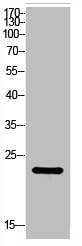
The antibody against GFER was raised in rabbit using the Synthesized peptide derived from the Internal region of Human ALR. as the immunogen. This antibody exists as a non-conjugated isotype IgG. The antibody was affinity-purified from rabbit antiserum by affinity-chromatography using epitope-specific immunogen. This antibody has been validated on WB, ELISA.
$167.00
| Cat.No | ADC-36846A | Clonality | Polyclonal |
|---|---|---|---|
| Host Species | Rabbit | Target Name | Gfer |
| Form | Liquid | Species Reactivity | Human, Mouse, Rat |
| Isotype | IgG | Storage Buffer | 0.5% BSA and 0.02% sodium azide., Liquid in PBS containing 50% glycerol |
| Purification Method | The antibody was affinity-purified from rabbit antiserum by affinity-chromatography using epitope-specific immunogen. | Conjugate | Non-conjugated |
| Application | ELISA, WB | Storage | Upon receipt |
| Immunogen Description | Synthesized peptide derived from the Internal region of Human ALR. | Target Species | Human |
|---|---|---|---|
| Immunogen Sequence | Complete sequences for the immunogen, target protein, and peptides are available upon request. | Uniprot ID | P55789 |
Uniprot Id
P55789
Target Species
Human
Target Name
GFER
Target Full Name
FAD-linked sulfhydryl oxidase ALR
Target Function
FAD-dependent sulfhydryl oxidase that regenerates the redox-active disulfide bonds in CHCHD4/MIA40, a chaperone essential for disulfide bond formation and protein folding in the mitochondrial intermembrane space. The reduced form of CHCHD4/MIA40 forms a transient intermolecular disulfide bridge with GFER/ERV1, resulting in regeneration of the essential disulfide bonds in CHCHD4/MIA40, while GFER/ERV1 becomes re-oxidized by donating electrons to cytochrome c or molecular oxygen.; May act as an autocrine hepatotrophic growth factor promoting liver regeneration.
Target Involvement
Myopathy, mitochondrial progressive, with congenital cataract, hearing loss and developmental delay (MPMCHD)
Target Subcellular Location
[Isoform 1]: Mitochondrion intermembrane space. Mitochondrion.; [Isoform 2]: Cytoplasm. Secreted.
Target Tissue Specificity
Ubiquitously expressed. Highest expression in the testis and liver and low expression in the muscle.
Target Synonyms
ALR_HUMAN; Augmenter of liver regeneration; ERV1; ERV1 homolog; Erv1 like growth factor; FAD-linked sulfhydryl oxidase ALR; GFER; Growth factor augmenter of liver regeneration; Growth factor erv1 like; Hepatic regenerative stimulation substance; Hepatopoietin; Hepatopoietin protein; hERV1; HPO; HPO1; HPO2; HSS
Target Background
The hepatotrophic factor designated augmenter of liver regeneration (ALR) is thought to be one of the factors responsible for the extraordinary regenerative capacity of mammalian liver. It has also been called hepatic regenerative stimulation substance (HSS). The gene resides on chromosome 16 in the interval containing the locus for polycystic kidney disease (PKD1). The putative gene product is 42% similar to the scERV1 protein of yeast. The yeast scERV1 gene had been found to be essential for oxidative phosphorylation, the maintenance of mitochondrial genomes, and the cell division cycle. The human gene is both the structural and functional homolog of the yeast scERV1 gene.
Notification