-
Chinese (Simplified)
-
English
-
German
-
Korean
-
Spanish
Chinese (Simplified)
English
German
Korean
Spanish
Sign up for an account to enjoy easy online shopping and instant order tracking.
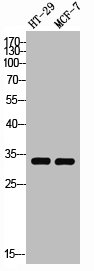
The antibody against STX1A was raised in rabbit using the Synthesized peptide derived from Human Syntaxin 1 around the non-phosphorylation site of S14. as the immunogen. This antibody exists as a non-conjugated isotype IgG. The antibody was affinity-purified from rabbit antiserum by affinity-chromatography using epitope-specific immunogen. This antibody has been validated on WB, IHC, IF, ELISA.
$167.00
| Cat.No | ADC-37532A | Clonality | Polyclonal |
|---|---|---|---|
| Host Species | Rabbit | Target Name | STX1A |
| Form | Liquid | Species Reactivity | Human, Mouse, Rat, Monkey |
| Isotype | IgG | Storage Buffer | 0.5% BSA and 0.02% sodium azide., Liquid in PBS containing 50% glycerol |
| Purification Method | The antibody was affinity-purified from rabbit antiserum by affinity-chromatography using epitope-specific immunogen. | Conjugate | Non-conjugated |
| Application | ELISA, IF, IHC, WB | Storage | Upon receipt |
| Immunogen Description | Synthesized peptide derived from Human Syntaxin 1 around the non-phosphorylation site of S14. | Target Species | Human |
|---|---|---|---|
| Immunogen Sequence | Complete sequences for the immunogen, target protein, and peptides are available upon request. | Uniprot ID | Q16623 |
Uniprot Id
Q16623
Target Species
Human
Target Name
STX1A
Target Full Name
Syntaxin-1A
Target Function
Plays an essential role in hormone and neurotransmitter calcium-dependent exocytosis and endocytosis. Part of the SNARE (Soluble NSF Attachment Receptor) complex composed of SNAP25, STX1A and VAMP2 which mediates the fusion of synaptic vesicles with the presynaptic plasma membrane. STX1A and SNAP25 are localized on the plasma membrane while VAMP2 resides in synaptic vesicles. The pairing of the three SNAREs from the N-terminal SNARE motifs to the C-terminal anchors leads to the formation of the SNARE complex, which brings membranes into close proximity and results in final fusion. Participates in the calcium-dependent regulation of acrosomal exocytosis in sperm. Plays also an important role in the exocytosis of hormones such as insulin or glucagon-like peptide 1 (GLP-1).
Target Involvement
STX1A is located in the Williams-Beuren syndrome (WBS) critical region. WBS results from a hemizygous deletion of several genes on chromosome 7q11.23, thought to arise as a consequence of unequal crossing over between highly homologous low-copy repeat sequences flanking the deleted region.
Target Subcellular Location
Cytoplasmic vesicle, secretory vesicle, synaptic vesicle membrane; Single-pass type IV membrane protein. Cell junction, synapse, synaptosome. Cell membrane.; [Isoform 2]: Secreted.
Target Protein Families
Syntaxin family
Target Tissue Specificity
Isoform 1 is highly expressed in embryonic spinal chord and ganglia and in adult cerebellum and cerebral cortex. Isoform 2 is expressed in heart, liver, fat, skeletal muscle, kidney and brain.
Target Synonyms
HPC 1; Neuron specific antigen HPC1; Neuron-specific antigen HPC-1; OTTHUMP00000174615; OTTHUMP00000174616; OTTHUMP00000174617; OTTHUMP00000174618; P35-1; STX1; STX1A; STX1A_HUMAN; SYN1A; Syntaxin 1A (brain); Syntaxin 1A brain; Syntaxin-1A
Target Background
This gene encodes a member of the syntaxin superfamily. Syntaxins are nervous system-specific proteins implicated in the docking of synaptic vesicles with the presynaptic plasma membrane. Syntaxins possess a single C-terminal transmembrane domain, a SNARE [Soluble NSF (N-ethylmaleimide-sensitive fusion protein)-Attachment protein REceptor] domain (known as H3), and an N-terminal regulatory domain (Habc). Syntaxins bind synaptotagmin in a calcium-dependent fashion and interact with voltage dependent calcium and potassium channels via the C-terminal H3 domain. This gene product is a key molecule in ion channel regulation and synaptic exocytosis. Alternatively spliced transcript variants encoding different isoforms have been found for this gene.
Notification