-
Chinese (Simplified)
-
English
-
German
-
Korean
-
Spanish
Chinese (Simplified)
English
German
Korean
Spanish
Sign up for an account to enjoy easy online shopping and instant order tracking.
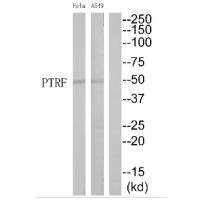
The antibody against CAVIN1 was raised in rabbit using the Synthesized peptide derived from Internal of Human PTRF. as the immunogen. The antibody was affinity-purified from rabbit antiserum by affinity-chromatography using epitope-specific immunogen. This antibody has been validated on ELISA, WB.
$297.00
| Cat.No | ADC-40785A | Clonality | Polyclonal |
|---|---|---|---|
| Host Species | Rabbit | Target Name | CAVIN1 |
| Form | Liquid | Species Reactivity | Human, Mouse, Rat |
| Storage Buffer | PH 7.4, 0.02% sodium azide and 50% glycerol., 150mM NaCl, Rabbit IgG in phosphate buffered saline (without Mg2+ and Ca2+) | Purification Method | The antibody was affinity-purified from rabbit antiserum by affinity-chromatography using epitope-specific immunogen. |
| Application | ELISA, WB | Storage | Upon receipt |
| Immunogen Description | Synthesized peptide derived from Internal of Human PTRF. | Target Species | Human |
|---|---|---|---|
| Immunogen Sequence | Complete sequences for the immunogen, target protein, and peptides are available upon request. | Uniprot ID | Q6NZI2 |
Uniprot Id
Q6NZI2
Target Species
Human
Target Name
CAVIN1
Target Full Name
Caveolae-associated protein 1
Target Function
Plays an important role in caveolae formation and organization. Essential for the formation of caveolae in all tissues. Core component of the CAVIN complex which is essential for recruitment of the complex to the caveolae in presence of calveolin-1 (CAV1). Essential for normal oligomerization of CAV1. Promotes ribosomal transcriptional activity in response to metabolic challenges in the adipocytes and plays an important role in the formation of the ribosomal transcriptional loop. Dissociates transcription complexes paused by DNA-bound TTF1, thereby releasing both RNA polymerase I and pre-RNA from the template. The caveolae biogenesis pathway is required for the secretion of proteins such as GASK1A.
Target Involvement
Congenital generalized lipodystrophy 4 (CGL4)
Target Subcellular Location
Membrane, caveola. Cell membrane. Microsome. Endoplasmic reticulum. Cytoplasm, cytosol. Mitochondrion. Nucleus.
Target Protein Families
CAVIN family
Target Synonyms
2310075E07Rik; AW546441; Cavin 1; Cavin; Cavin-1; CAVIN1; CGL4; FKSG13; FLJ90031; MGC118550; OTTMUSP00000002049; Polymerase I and transcript release factor; Ptrf; PTRF_HUMAN; RNA polymerase I and transcript release factor; RP23-279L23.6; TTF I interacting peptide 12
Target Background
This gene encodes a protein that enables the dissociation of paused ternary polymerase I transcription complexes from the 3' end of pre-rRNA transcripts. This protein regulates rRNA transcription by promoting the dissociation of transcription complexes and the reinitiation of polymerase I on nascent rRNA transcripts. This protein also localizes to caveolae at the plasma membrane and is thought to play a critical role in the formation of caveolae and the stabilization of caveolins. This protein translocates from caveolae to the cytoplasm after insulin stimulation. Caveolae contain truncated forms of this protein and may be the site of phosphorylation-dependent proteolysis. This protein is also thought to modify lipid metabolism and insulin-regulated gene expression. Mutations in this gene result in a disorder characterized by generalized lipodystrophy and muscular dystrophy.
Notification