-
Chinese (Simplified)
-
English
-
German
-
Korean
-
Spanish
Chinese (Simplified)
English
German
Korean
Spanish
Sign up for an account to enjoy easy online shopping and instant order tracking.
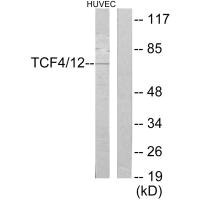
The antibody against TCF4/TCF12 was raised in rabbit using the Synthesized peptide derived from internal of Human TCF4/12. as the immunogen. The antibody was affinity-purified from rabbit antiserum by affinity-chromatography using epitope-specific immunogen. This antibody has been validated on ELISA, WB.
$297.00
| Cat.No | ADC-40857A | Clonality | Polyclonal |
|---|---|---|---|
| Host Species | Rabbit | Target Name | TCF4/TCF12 |
| Target Synonyms | isoform C antibody; Transcription factor 4, isoform D antibody; Transcription factor 4, isoform E antibody; Transcription factor 4, isoform L antibody; Transcription factor 4, isoform M antibody; Transcription factor 4, isoform R antibody | Form | Liquid |
| Species Reactivity | Human, Mouse, Rat | Storage Buffer | PH 7.4, 0.02% sodium azide and 50% glycerol., 150mM NaCl, Rabbit IgG in phosphate buffered saline (without Mg2+ and Ca2+) |
| Purification Method | The antibody was affinity-purified from rabbit antiserum by affinity-chromatography using epitope-specific immunogen. | Application | ELISA, WB |
| Storage | Upon receipt |
| Immunogen Description | Synthesized peptide derived from internal of Human TCF4/12. | Target Species | Human |
|---|---|---|---|
| Immunogen Sequence | Complete sequences for the immunogen, target protein, and peptides are available upon request. | Uniprot ID | P15884 |
Uniprot Id
P15884
Target Species
Human
Target Name
TCF4
Target Full Name
Transcription factor 4
Target Function
Transcription factor that binds to the immunoglobulin enhancer Mu-E5/KE5-motif. Involved in the initiation of neuronal differentiation. Activates transcription by binding to the E box (5'-CANNTG-3'). Binds to the E-box present in the somatostatin receptor 2 initiator element (SSTR2-INR) to activate transcription. Preferentially binds to either 5'-ACANNTGT-3' or 5'-CCANNTGG-3'.
Target Involvement
Pitt-Hopkins syndrome (PTHS); Corneal dystrophy, Fuchs endothelial, 3 (FECD3)
Target Subcellular Location
Nucleus.
Target Tissue Specificity
Expressed in adult heart, brain, placenta, skeletal muscle and to a lesser extent in the lung. In developing embryonic tissues, expression mostly occurs in the brain.
Target Synonyms
bHLHb19; Class B basic helix-loop-helix protein 19; E2 2; FECD3; Immunoglobulin transcription factor 2; ITF 2; ITF-2; ITF2; ITF2_HUMAN; MGC149723; MGC149724; PTHS; SEF 2; SEF-2; SEF2 1; SEF2 1A; SEF2 1B; SEF2 1D; SEF2; SL3 3 enhancer factor 2; SL3-3 enhancer factor 2; TCF 4; TCF-4; TCF4; Transcription factor 4; Transcription factor 4, isoform C; Transcription factor 4, isoform D; Transcription factor 4, isoform E; Transcription factor 4, isoform L; Transcription factor 4, isoform M; Transcription factor 4, isoform R
Target Background
This gene encodes transcription factor 4, a basic helix-loop-helix transcription factor. The encoded protein recognizes an Ephrussi-box ('E-box') binding site ('CANNTG') - a motif first identified in immunoglobulin enhancers. This gene is broadly expressed, and may play an important role in nervous system development. Defects in this gene are a cause of Pitt-Hopkins syndrome. In addition, an intronic CTG repeat normally numbering 10-37 repeat units can expand to >50 repeat units and cause Fuchs endothelial corneal dystrophy. Multiple alternatively spliced transcript variants that encode different proteins have been described.
Notification