-
Chinese (Simplified)
-
English
-
German
-
Korean
-
Spanish
Chinese (Simplified)
English
German
Korean
Spanish
Sign up for an account to enjoy easy online shopping and instant order tracking.
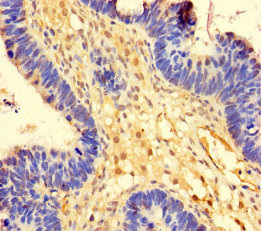
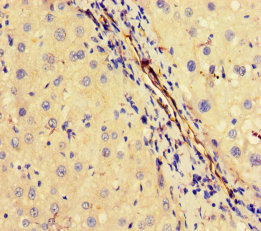
The antibody against OTUB1 was raised in rabbit using the Recombinant Human Ubiquitin thioesterase OTUB1 protein (2-201AA) as the immunogen. This antibody exists as a non-conjugated isotype IgG, purified by protein G with a purity greater than 95%. This antibody has been validated on ELISA, WB, IHC.
$299.00
| Cat.No | ADC-50440A | Clonality | Polyclonal |
|---|---|---|---|
| Host Species | Rabbit | Target Name | OTUB1 |
| Target Synonyms | Deubiquitinating enzyme OTUB1 antibody; hOTU1 antibody; HSPC263 antibody; OTB1 antibody; OTU domain containing ubiquitin aldehyde binding protein 1 antibody; OTU domain | Form | Liquid |
| Species Reactivity | Human | Isotype | IgG |
| Storage Buffer | 0.01M PBS, 0.03% Proclin 300; Constituents: 50% Glycerol, PH 7.4 | Purification Method | >95%, Protein G purified |
| Conjugate | Non-conjugated | Application | ELISA, IHC, WB |
| Storage | Upon receipt |
| Immunogen Description | Recombinant Human Ubiquitin thioesterase OTUB1 protein (2-201AA) | Target Species | Human |
|---|---|---|---|
| Immunogen Sequence | Complete sequences for the immunogen, target protein, and peptides are available upon request. | Uniprot ID | Q96FW1 |
Uniprot Id
Q96FW1
Target Species
Human
Target Name
OTUB1
Target Full Name
Ubiquitin thioesterase OTUB1
Target Function
Hydrolase that can specifically remove 'Lys-48'-linked conjugated ubiquitin from proteins and plays an important regulatory role at the level of protein turnover by preventing degradation. Regulator of T-cell anergy, a phenomenon that occurs when T-cells are rendered unresponsive to antigen rechallenge and no longer respond to their cognate antigen. Acts via its interaction with RNF128/GRAIL, a crucial inductor of CD4 T-cell anergy. Isoform 1 destabilizes RNF128, leading to prevent anergy. In contrast, isoform 2 stabilizes RNF128 and promotes anergy. Surprisingly, it regulates RNF128-mediated ubiquitination, but does not deubiquitinate polyubiquitinated RNF128. Deubiquitinates estrogen receptor alpha (ESR1). Mediates deubiquitination of 'Lys-48'-linked polyubiquitin chains, but not 'Lys-63'-linked polyubiquitin chains. Not able to cleave di-ubiquitin. Also capable of removing NEDD8 from NEDD8 conjugates, but with a much lower preference compared to 'Lys-48'-linked ubiquitin.; Plays a key non-catalytic role in DNA repair regulation by inhibiting activity of RNF168, an E3 ubiquitin-protein ligase that promotes accumulation of 'Lys-63'-linked histone H2A and H2AX at DNA damage sites. Inhibits RNF168 independently of ubiquitin thioesterase activity by binding and inhibiting UBE2N/UBC13, the E2 partner of RNF168, thereby limiting spreading of 'Lys-63'-linked histone H2A and H2AX marks. Inhibition occurs by binding to free ubiquitin: free ubiquitin acts as an allosteric regulator that increases affinity for UBE2N/UBC13 and disrupts interaction with UBE2V1. The OTUB1-UBE2N/UBC13-free ubiquitin complex adopts a configuration that mimics a cleaved 'Lys48'-linked di-ubiquitin chain.
Target Subcellular Location
Cytoplasm.
Target Protein Families
Peptidase C65 family
Target Tissue Specificity
Isoform 1 is ubiquitous. Isoform 2 is expressed only in lymphoid tissues such as tonsils, lymph nodes and spleen, as well as peripheral blood mononuclear cells.
Target Research Area
Immunology
Target Synonyms
Deubiquitinating enzyme OTUB1; hOTU1; HSPC263; OTB1; OTU domain containing ubiquitin aldehyde binding protein 1; OTU domain, ubiquitin aldehyde binding 1; OTU domain-containing Ubal-binding protein 1; OTU domain-containing ubiquitin aldehyde-binding protein 1; OTU-domain Ubal-binding 1; OTU1; Otub1; OTUB1_HUMAN; Otubain 1; Otubain-1; Ubiquitin specific processing protease OTUB1; Ubiquitin thioesterase OTUB1; ubiquitin-specific protease otubain 1; Ubiquitin-specific-processing protease OTUB1
Target Background
The product of this gene is a member of the OTU (ovarian tumor) superfamily of predicted cysteine proteases. The encoded protein is a highly specific ubiquitin iso-peptidase, and cleaves ubiquitin from branched poly-ubiquitin chains but not from ubiquitinated substrates. It interacts with another ubiquitin protease and an E3 ubiquitin ligase that inhibits cytokine gene transcription in the immune system. It is proposed to function in specific ubiquitin-dependent pathways, possibly by providing an editing function for polyubiquitin chain growth. Alternative splicing results in multiple transcript variants.
Notification