-
Chinese (Simplified)
-
English
-
German
-
Korean
-
Spanish
Chinese (Simplified)
English
German
Korean
Spanish
Sign up for an account to enjoy easy online shopping and instant order tracking.
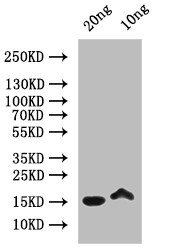
The antibody against MELT was raised in rabbit using the Recombinant Apis mellifera MELT protein (44-69aa) as the immunogen. This antibody exists as a non-conjugated isotype IgG, purified by protein G with a purity greater than 95%. This antibody has been validated on ELISA, WB.
$299.00
| Cat.No | ADC-54720A | Clonality | Polyclonal |
|---|---|---|---|
| Host Species | Rabbit | Target Name | MELT |
| Target Synonyms | Melittin (Allergen Api m 3) (Allergen Api m III) (allergen Api m 4), MELT | Form | Liquid |
| Species Reactivity | Apis mellifera | Isotype | IgG |
| Storage Buffer | 0.01M PBS, 0.03% Proclin 300; Constituents: 50% Glycerol, PH 7.4 | Purification Method | >95%, Protein G purified |
| Conjugate | Non-conjugated | Application | ELISA, WB |
| Immunogen Description | Recombinant Apis mellifera MELT protein (44-69aa) | Target Species | Apis mellifera (Honeybee) |
|---|---|---|---|
| Immunogen Sequence | Complete sequences for the immunogen, target protein, and peptides are available upon request. | Uniprot ID | P01501 |
Uniprot Id
P01501
Target Species
Apis mellifera
Target Name
MELT
Target Function
Melittin: Main toxin of bee venom with strong hemolytic activity and antimicrobial activity. It has enhancing effects on bee venom phospholipase A2 activity. This amphipathic toxin binds to negatively charged membrane surface and forms pore by inserting into lipid bilayers inducing the leakage of ions and molecules and the enhancement of permeability that ultimately leads to cell lysis. It acts as a voltage-gated pore with higher selectivity for anions over cations. The ion conductance has been shown to be voltage-dependent. Self-association of melittin in membranes is promoted by high ionic strength, but not by the presence of negatively charged lipids. In vivo, intradermal injection into healthy human volunteers produce sharp pain sensation and an inflammatory response. It produces pain by activating primary nociceptor cells directly and indirectly due to its ability to activate plasma membrane phospholipase A2 and its pore-forming activity.; Melittin-S: 1.4-fold less hemolytic and adopts a less organized secondary structure than melittin.; Melittin-2: Has strong hemolytic activity.
Target Subcellular Location
Secreted. Target cell membrane.
Target Protein Families
Melittin family
Target Tissue Specificity
Expressed by the venom gland.
Notification