-
Chinese (Simplified)
-
English
-
German
-
Korean
-
Spanish
Chinese (Simplified)
English
German
Korean
Spanish
Sign up for an account to enjoy easy online shopping and instant order tracking.
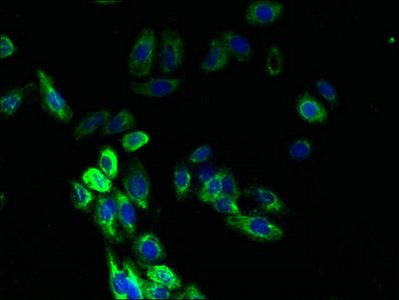
The antibody against ACKR1 was raised in rabbit using the Recombinant Human Atypical chemokine receptor 1 protein (1-63AA) as the immunogen. This antibody exists as a non-conjugated isotype IgG, purified by protein G with a purity greater than 95%. This antibody has been validated on ELISA, WB, IF.
$299.00
| Cat.No | ADC-32665A | Clonality | Polyclonal |
|---|---|---|---|
| Host Species | Rabbit | Target Name | ACKR1 |
| Target Synonyms | ACKR1; DARC; FY; GPD; Atypical chemokine receptor 1; Duffy antigen/chemokine receptor; Fy glycoprotein; GpFy; Glycoprotein D; Plasmodium vivax receptor; CD antigen CD234 | Form | Liquid |
| Species Reactivity | Human, Mouse | Isotype | IgG |
| Storage Buffer | 0.01M PBS, 0.03% Proclin 300; Constituents: 50% Glycerol, PH 7.4 | Purification Method | >95%, Protein G purified |
| Conjugate | Non-conjugated | Application | ELISA, IF, WB |
| Storage | Upon receipt |
| Immunogen Description | Recombinant Human Atypical chemokine receptor 1 protein (1-63AA) | Target Species | Human |
|---|---|---|---|
| Immunogen Sequence | Complete sequences for the immunogen, target protein, and peptides are available upon request. | Uniprot ID | Q16570 |
Uniprot Id
Q16570
Target Species
Human
Target Name
ACKR1
Target Full Name
Atypical chemokine receptor 1
Target Function
Atypical chemokine receptor that controls chemokine levels and localization via high-affinity chemokine binding that is uncoupled from classic ligand-driven signal transduction cascades, resulting instead in chemokine sequestration, degradation, or transcytosis. Also known as interceptor (internalizing receptor) or chemokine-scavenging receptor or chemokine decoy receptor. Has a promiscuous chemokine-binding profile, interacting with inflammatory chemokines of both the CXC and the CC subfamilies but not with homeostatic chemokines. Acts as a receptor for chemokines including CCL2, CCL5, CCL7, CCL11, CCL13, CCL14, CCL17, CXCL5, CXCL6, IL8/CXCL8, CXCL11, GRO, RANTES, MCP-1, TARC and also for the malaria parasites P.vivax and P.knowlesi. May regulate chemokine bioavailability and, consequently, leukocyte recruitment through two distinct mechanisms: when expressed in endothelial cells, it sustains the abluminal to luminal transcytosis of tissue-derived chemokines and their subsequent presentation to circulating leukocytes; when expressed in erythrocytes, serves as blood reservoir of cognate chemokines but also as a chemokine sink, buffering potential surges in plasma chemokine levels.
Target Subcellular Location
Early endosome. Recycling endosome. Membrane; Multi-pass membrane protein. Note=Predominantly localizes to endocytic vesicles, and upon stimulation by the ligand is internalized via caveolae. Once internalized, the ligand dissociates from the receptor, and is targeted to degradation while the receptor is recycled back to the cell membrane.
Target Protein Families
G-protein coupled receptor 1 family, Atypical chemokine receptor subfamily
Target Tissue Specificity
Found in adult kidney, adult spleen, bone marrow and fetal liver. In particular, it is expressed along postcapillary venules throughout the body, except in the adult liver. Erythroid cells and postcapillary venule endothelium are the principle tissues exp
Target Synonyms
ACKR1; DARC; FY; GPD; Atypical chemokine receptor 1; Duffy antigen/chemokine receptor; Fy glycoprotein; GpFy; Glycoprotein D; Plasmodium vivax receptor; CD antigen CD234
Target Background
The protein encoded by this gene is a glycosylated membrane protein and a non-specific receptor for several chemokines. The encoded protein is the receptor for the human malarial parasites Plasmodium vivax and Plasmodium knowlesi. Polymorphisms in this gene are the basis of the Duffy blood group system. Two transcript variants encoding different isoforms have been found for this gene.
Notification