• Contact info@abtriva.com for inquiries and orders.
  • Chinese (Simplified)

  • English

  • German

  • Korean

  • Spanish

United States (English / $ USD)

Rabbit anti-Human ACTL6A Polyclonal Antibody

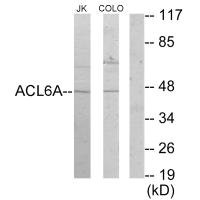
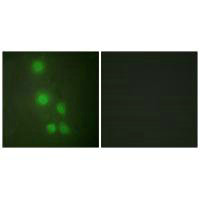
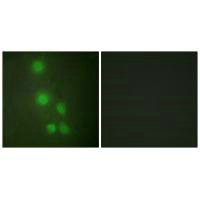
The antibody against ACTL6A was raised in rabbit using the Synthesized peptide derived from internal of Human ACL6A. as the immunogen. The antibody was affinity-purified from rabbit antiserum by affinity-chromatography using epitope-specific immunogen. This antibody has been validated on ELISA, WB, IF.

ADC-42177A

The antibody against ACTL6A was raised in rabbit using the Synthesized peptide derived from internal of Human ACL6A. as the immunogen. The antibody was affinity-purified from rabbit antiserum by affinity-chromatography using epitope-specific immunogen. This antibody has been validated on ELISA, WB, IF.

$297.00

Number
Order Exclusive Products Now

Request a Quote
High Purity LevelsPrecision and ReliabilityCustomization Options

Specifications


Cat.No ADC-42177A ClonalityPolyclonal
Host SpeciesRabbitTarget NameACTL6A
FormLiquidSpecies ReactivityHuman, Mouse, Rat
Storage BufferPH 7.4, 0.02% sodium azide and 50% glycerol., 150mM NaCl, Rabbit IgG in phosphate buffered saline (without Mg2+ and Ca2+)Purification MethodThe antibody was affinity-purified from rabbit antiserum by affinity-chromatography using epitope-specific immunogen.
ApplicationELISA, IF, WBStorageUpon receipt

Immunogen Information


Immunogen DescriptionSynthesized peptide derived from internal of Human ACL6A.Target SpeciesHuman
Immunogen SequenceComplete sequences for the immunogen, target protein, and peptides are available upon request.Uniprot IDO96019
Background Information
  • Uniprot Id

    O96019

  • Target Species

    Human

  • Target Name

    ACTL6A

  • Target Full Name

    Actin-like protein 6A

  • Target Function

    Involved in transcriptional activation and repression of select genes by chromatin remodeling (alteration of DNA-nucleosome topology). Component of SWI/SNF chromatin remodeling complexes that carry out key enzymatic activities, changing chromatin structure by altering DNA-histone contacts within a nucleosome in an ATP-dependent manner. Required for maximal ATPase activity of SMARCA4/BRG1/BAF190A and for association of the SMARCA4/BRG1/BAF190A containing remodeling complex BAF with chromatin/nuclear matrix. Belongs to the neural progenitors-specific chromatin remodeling complex (npBAF complex) and is required for the proliferation of neural progenitors. During neural development a switch from a stem/progenitor to a postmitotic chromatin remodeling mechanism occurs as neurons exit the cell cycle and become committed to their adult state. The transition from proliferating neural stem/progenitor cells to postmitotic neurons requires a switch in subunit composition of the npBAF and nBAF complexes. As neural progenitors exit mitosis and differentiate into neurons, npBAF complexes which contain ACTL6A/BAF53A and PHF10/BAF45A, are exchanged for homologous alternative ACTL6B/BAF53B and DPF1/BAF45B or DPF3/BAF45C subunits in neuron-specific complexes (nBAF). The npBAF complex is essential for the self-renewal/proliferative capacity of the multipotent neural stem cells. The nBAF complex along with CREST plays a role regulating the activity of genes essential for dendrite growth. Component of the NuA4 histone acetyltransferase (HAT) complex which is involved in transcriptional activation of select genes principally by acetylation of nucleosomal histones H4 and H2A. This modification may both alter nucleosome - DNA interactions and promote interaction of the modified histones with other proteins which positively regulate transcription. This complex may be required for the activation of transcriptional programs associated with oncogene and proto-oncogene mediated growth induction, tumor suppressor mediated growth arrest and replicative senescence, apoptosis, and DNA repair. NuA4 may also play a direct role in DNA repair when recruited to sites of DNA damage. Putative core component of the chromatin remodeling INO80 complex which is involved in transcriptional regulation, DNA replication and probably DNA repair.

  • Target Involvement

    ACTL6A mutations have been found in patients with intellectual disability of variable severity, developmental delay, dysmorphic features and digit abnormalities. Additional features may include genitourinary and cardiac defects. The disease phenotype resembles Coffin-Siris syndrome and brachymorphism-onychodysplasia-dysphalangism syndrome.

  • Target Subcellular Location

    Nucleus.

  • Target Protein Families

    Actin family

  • Target Synonyms

    53 kDa BRG1 associated factor A; 53 kDa BRG1-associated factor A; ACL6A_HUMAN; Actin like 6A; Actin like protein 6A; Actin related protein 4; Actin related protein; Actin related protein Baf53a; Actin-like protein 6A; Actin-related protein Baf53a; ACTL 6; ACTL 6A; ACTL6; ACTL6A; Arp4; ARPN BETA; ArpNbeta; BAF 53A; BAF complex 53 kDa subunit; BAF53; BAF53A; BRG1 associated factor; BRG1-associated factor 53A; hArpN beta; INO80 complex subunit K; INO80K; MGC5382

  • Target Background

    This gene encodes a family member of actin-related proteins (ARPs), which share significant amino acid sequence identity to conventional actins. Both actins and ARPs have an actin fold, which is an ATP-binding cleft, as a common feature. The ARPs are involved in diverse cellular processes, including vesicular transport, spindle orientation, nuclear migration and chromatin remodeling. This gene encodes a 53 kDa subunit protein of the BAF (BRG1/brm-associated factor) complex in mammals, which is functionally related to SWI/SNF complex in S. cerevisiae and Drosophila; the latter is thought to facilitate transcriptional activation of specific genes by antagonizing chromatin-mediated transcriptional repression. Together with beta-actin, it is required for maximal ATPase activity of BRG1, and for the association of the BAF complex with chromatin/matrix. Three transcript variants that encode two different protein isoforms have been described.

Inquire Rabbit anti-Human ACTL6A Polyclonal Antibody Now


AbTriva respects your privacy and protects your personal data in accordance with AbTriva. For more information, please see our data protection statement. *

Notification