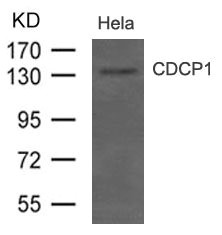
-
Chinese (Simplified)
-
English
-
German
-
Korean
-
Spanish
Chinese (Simplified)
English
German
Korean
Spanish
Sign up for an account to enjoy easy online shopping and instant order tracking.
The antibody against CDCP1 was raised in rabbit using the Peptide sequence around aa.828~832( T-Q-E-P-M) derived from Human CDCP1(CD318). as the immunogen. Antibodies were produced by immunizing rabbits with synthetic peptide and KLH conjugates. Antibodies were purified by affinity-chromatography using epitope-specific peptide. This antibody has been validated on ELISA, WB.
$297.00
| Cat.No | ADC-43167A | Clonality | Polyclonal |
|---|---|---|---|
| Host Species | Rabbit | Target Name | CDCP1 |
| Form | Liquid | Species Reactivity | Human |
| Storage Buffer | PH 7.4, 0.02% sodium azide and 50% glycerol., 150mM NaCl, Supplied at 1.0mg/mL in phosphate buffered saline (without Mg2+ and Ca2+) | Purification Method | Antibodies were produced by immunizing rabbits with synthetic peptide and KLH conjugates. Antibodies were purified by affinity-chromatography using epitope-specific peptide. |
| Application | ELISA, WB | Storage | Upon receipt |
| Immunogen Description | Peptide sequence around aa.828~832( T-Q-E-P-M) derived from Human CDCP1(CD318). | Target Species | Human |
|---|---|---|---|
| Immunogen Sequence | Complete sequences for the immunogen, target protein, and peptides are available upon request. | Uniprot ID | Q9H5V8 |
Uniprot Id
Q9H5V8
Target Species
Human
Target Name
CDCP1
Target Full Name
CUB domain-containing protein 1
Target Function
May be involved in cell adhesion and cell matrix association. May play a role in the regulation of anchorage versus migration or proliferation versus differentiation via its phosphorylation. May be a novel marker for leukemia diagnosis and for immature hematopoietic stem cell subsets. Belongs to the tetraspanin web involved in tumor progression and metastasis.
Target Subcellular Location
[Isoform 1]: Cell membrane; Single-pass membrane protein. Note=Shedding may also lead to a soluble peptide.; [Isoform 3]: Secreted.
Target Tissue Specificity
Highly expressed in mitotic cells with low expression during interphase. Detected at highest levels in skeletal muscle and colon with lower levels in kidney, small intestine, placenta and lung. Up-regulated in a number of human tumor cell lines, as well a
Target Synonyms
9030022E12Rik; AA409659; CD 318; CD_antigen=CD318; CD318; CD318 antigen; CDCP 1; Cdcp1; CDCP1_HUMAN; CUB domain containing protein 1; CUB domain-containing protein 1; E030027H19Rik; FLJ13772; FLJ22375; FLJ22969; Membrane glycoprotein gp140; MGC31813; OTTHUMP00000164120; OTTHUMP00000209568; RGD1305578; SIMA 135; SIMA135; Subtractive immunization M plus HEp3 associated 135 kDa protein; Subtractive immunization M plus HEp3-associated 135 kDa protein; Transmembrane and associated with src kinases; TRASK
Target Background
This gene encodes a transmembrane protein which contains three extracellular CUB domains and acts as a substrate for Src family kinases. The protein plays a role in the tyrosine phosphorylation-dependent regulation of cellular events that are involved in tumor invasion and metastasis. Alternative splicing results in multiple transcript variants of this gene.
Notification