-
Chinese (Simplified)
-
English
-
German
-
Korean
-
Spanish
Chinese (Simplified)
English
German
Korean
Spanish
Sign up for an account to enjoy easy online shopping and instant order tracking.
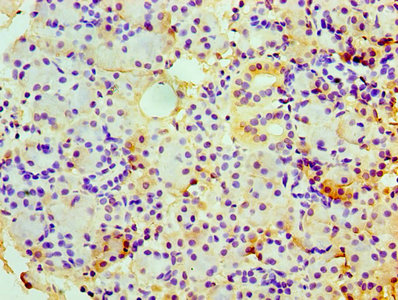
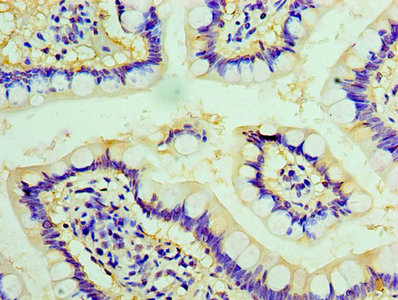
The antibody against CHGA was raised in rabbit using the Recombinant Human Chromogranin-A protein (19-457AA) as the immunogen. This antibody exists as a non-conjugated isotype IgG, purified by protein G with a purity greater than 95%. This antibody has been validated on ELISA, IHC.
$299.00
| Cat.No | ADC-49911A | Clonality | Polyclonal |
|---|---|---|---|
| Host Species | Rabbit | Target Name | CHGA |
| Form | Liquid | Species Reactivity | Human |
| Isotype | IgG | Storage Buffer | 0.01M PBS, 0.03% Proclin 300; Constituents: 50% Glycerol, PH 7.4 |
| Purification Method | >95%, Protein G purified | Conjugate | Non-conjugated |
| Application | ELISA, IHC | Storage | Upon receipt |
| Immunogen Description | Recombinant Human Chromogranin-A protein (19-457AA) | Target Species | Human |
|---|---|---|---|
| Immunogen Sequence | Complete sequences for the immunogen, target protein, and peptides are available upon request. | Uniprot ID | P10645 |
Uniprot Id
P10645
Target Species
Human
Target Name
CHGA
Target Full Name
Chromogranin-A
Target Function
Strongly inhibits glucose induced insulin release from the pancreas.; Inhibits catecholamine release from chromaffin cells and noradrenergic neurons by acting as a non-competitive nicotinic cholinergic antagonist. Displays antibacterial activity against Gram-positive bacteria S.aureus and M.luteus, and Gram-negative bacteria E.coli and P.aeruginosa. Can induce mast cell migration, degranulation and production of cytokines and chemokines. Acts as a potent scavenger of free radicals in vitro. May play a role in the regulation of cardiac function and blood pressure.; Regulates granule biogenesis in endocrine cells by up-regulating the transcription of protease nexin 1 (SERPINE2) via a cAMP-PKA-SP1 pathway. This leads to inhibition of granule protein degradation in the Golgi complex which in turn promotes granule formation.
Target Subcellular Location
[Serpinin]: Secreted. Cytoplasmic vesicle, secretory vesicle.; Cytoplasmic vesicle, secretory vesicle. Cytoplasmic vesicle, secretory vesicle, neuronal dense core vesicle. Secreted.
Target Protein Families
Chromogranin/secretogranin protein family
Target Tissue Specificity
GE-25 is found in the brain.
Target Research Area
Cancer
Target Synonyms
beta Granin; betagranin (N-terminal fragment of chromogranin A); catestatin; CgA; CHG A; Chga; chromofungin; Chromogranin A; Chromogranin A parathyroid secretory protein 1; Chromogranin A precursor; ChromograninA; CMGA_HUMAN; ER-37; Pancreastatin; Parastatin; Parathyroid secretory protein 1; Pituitary secretory protein I; Secretory protein I; SP I; SP-I; SP1; SPI; vasostatin 2; Vasostatin; Vasostatin I; Vasostatin II; vasostatin-2
Target Background
The protein encoded by this gene is a member of the chromogranin/secretogranin family of neuroendocrine secretory proteins. It is found in secretory vesicles of neurons and endocrine cells. This gene product is a precursor to three biologically active peptides; vasostatin, pancreastatin, and parastatin. These peptides act as autocrine or paracrine negative modulators of the neuroendocrine system. Two other peptides, catestatin and chromofungin, have antimicrobial activity and antifungal activity, respectively. Two transcript variants encoding different isoforms have been found for this gene.
Notification