-
Chinese (Simplified)
-
English
-
German
-
Korean
-
Spanish
Chinese (Simplified)
English
German
Korean
Spanish
Sign up for an account to enjoy easy online shopping and instant order tracking.
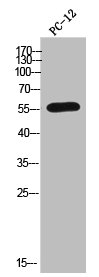
The antibody against CYP2A6 was raised in rabbit using the Synthesized peptide derived from the N-terminal region of Human CYP2A6. as the immunogen. This antibody exists as a non-conjugated isotype IgG. The antibody was affinity-purified from rabbit antiserum by affinity-chromatography using epitope-specific immunogen. This antibody has been validated on WB, IF, ELISA.
$167.00
| Cat.No | ADC-36201A | Clonality | Polyclonal |
|---|---|---|---|
| Host Species | Rabbit | Target Name | CYP2A6 |
| Form | Liquid | Species Reactivity | Human |
| Isotype | IgG | Storage Buffer | 0.5% BSA and 0.02% sodium azide., Liquid in PBS containing 50% glycerol |
| Purification Method | The antibody was affinity-purified from rabbit antiserum by affinity-chromatography using epitope-specific immunogen. | Conjugate | Non-conjugated |
| Application | ELISA, IF, WB | Storage | Upon receipt |
| Immunogen Description | Synthesized peptide derived from the N-terminal region of Human CYP2A6. | Target Species | Human |
|---|---|---|---|
| Immunogen Sequence | Complete sequences for the immunogen, target protein, and peptides are available upon request. | Uniprot ID | P11509 |
Uniprot Id
P11509
Target Species
Human
Target Name
CYP2A6
Target Full Name
Cytochrome P450 2A6
Target Function
Exhibits a high coumarin 7-hydroxylase activity. Can act in the hydroxylation of the anti-cancer drugs cyclophosphamide and ifosphamide. Competent in the metabolic activation of aflatoxin B1. Constitutes the major nicotine C-oxidase. Acts as a 1,4-cineole 2-exo-monooxygenase. Possesses low phenacetin O-deethylation activity.
Target Subcellular Location
Endoplasmic reticulum membrane; Peripheral membrane protein. Microsome membrane; Peripheral membrane protein.
Target Protein Families
Cytochrome P450 family
Target Tissue Specificity
Liver.
Target Research Area
Cardiovascular
Target Synonyms
Coumarin 7 hydroxylase; Coumarin 7-hydroxylase; CP2A6_HUMAN; CPA6; CYP2A; CYP2A3; CYP2A6; CYPIIA6; Cytochrome P450 2A6; Cytochrome P450 IIA3; Cytochrome P450 subfamily IIA (phenobarbital inducible) polypeptide 6; Cytochrome P450(I); Cytochrome P450; family 2 subfamily A polypeptide 6; Flavoprotein linked monooxygenase; P450C2A; P450PB; Xenobiotic monooxygenase
Target Background
This gene, CYP2A6, encodes a member of the cytochrome P450 superfamily of enzymes. The cytochrome P450 proteins are monooxygenases which catalyze many reactions involved in drug metabolism and synthesis of cholesterol, steroids and other lipids. This protein localizes to the endoplasmic reticulum and its expression is induced by phenobarbital. The enzyme is known to hydroxylate coumarin, and also metabolizes nicotine, aflatoxin B1, nitrosamines, and some pharmaceuticals. Individuals with certain allelic variants are said to have a poor metabolizer phenotype, meaning they do not efficiently metabolize coumarin or nicotine. This gene is part of a large cluster of cytochrome P450 genes from the CYP2A, CYP2B and CYP2F subfamilies on chromosome 19q. The gene was formerly referred to as CYP2A3; however, it has been renamed CYP2A6.
Notification