-
Chinese (Simplified)
-
English
-
German
-
Korean
-
Spanish
Chinese (Simplified)
English
German
Korean
Spanish
Sign up for an account to enjoy easy online shopping and instant order tracking.
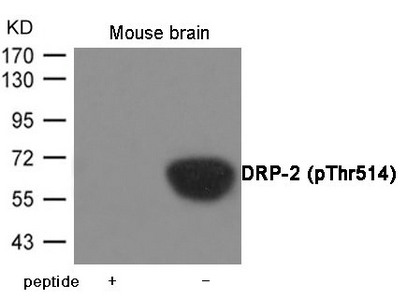
The antibody against DPYSL2 was raised in rabbit using the Peptide sequence around phosphorylation site of Threonine 514(K-V-T(p)-P-A) derived from Human DRP-2. as the immunogen. Antibodies were produced by immunizing rabbits with synthetic phosphopeptide and KLH conjugates. Antibodies were purified by affinity-chromatography using epitope-specific phosphopeptide. Non-phospho specific antibodies were removed by chromatogramphy usi This antibody has been validated on ELISA, WB.
$360.00
| Cat.No | ADC-42969A | Clonality | Polyclonal |
|---|---|---|---|
| Host Species | Rabbit | Target Name | DPYSL2 |
| Form | Liquid | Species Reactivity | Human, Mouse, Rat |
| Storage Buffer | PH 7.4, 0.02% sodium azide and 50% glycerol., 150mM NaCl, Supplied at 1.0mg/mL in phosphate buffered saline (without Mg2+ and Ca2+) | Application | ELISA, WB |
| Storage | Upon receipt |
| Immunogen Description | Peptide sequence around phosphorylation site of Threonine 514(K-V-T(p)-P-A) derived from Human DRP-2. | Target Species | Human |
|---|---|---|---|
| Immunogen Sequence | Complete sequences for the immunogen, target protein, and peptides are available upon request. | Uniprot ID | Q16555 |
Uniprot Id
Q16555
Target Species
Human
Target Name
DPYSL2
Target Full Name
Dihydropyrimidinase-related protein 2
Target Function
Plays a role in neuronal development and polarity, as well as in axon growth and guidance, neuronal growth cone collapse and cell migration. Necessary for signaling by class 3 semaphorins and subsequent remodeling of the cytoskeleton. May play a role in endocytosis.
Target Subcellular Location
Cytoplasm, cytosol. Cytoplasm, cytoskeleton. Membrane. Note=Tightly but non-covalently associated with membranes.
Target Protein Families
Metallo-dependent hydrolases superfamily, Hydantoinase/dihydropyrimidinase family
Target Tissue Specificity
Ubiquitous.
Target Research Area
Developmental Biology
Target Synonyms
Collapsin response mediator protein 2; Collapsin response mediator protein; Collapsin response mediator protein hCRMP 2; CRAM; CRMP 2; CRMP-2; CRMP2; DHPRP 2; DHPRP2; Dihydropyrimidinase 2; Dihydropyrimidinase like 2; Dihydropyrimidinase like 2 long form; Dihydropyrimidinase related protein 2; Dihydropyrimidinase-related protein 2; DPYL 2; DPYL2; DPYL2_HUMAN; DPYSL 2; Dpysl2; DRP-2; DRP2; Musunc 33; Musunc33; N2A3; TOAD 64; TOAD64; ULIP 2 protein; ULIP-2; Ulip2; Unc-33-like phosphoprotein 2
Target Background
This gene encodes a member of the collapsin response mediator protein family. Collapsin response mediator proteins form homo- and hetero-tetramers and facilitate neuron guidance, growth and polarity. The encoded protein promotes microtubule assembly and is required for Sema3A-mediated growth cone collapse, and also plays a role in synaptic signaling through interactions with calcium channels. This gene has been implicated in multiple neurological disorders, and hyperphosphorylation of the encoded protein may play a key role in the development of Alzheimer's disease. Alternatively spliced transcript variants encoding multiple isoforms have been observed for this gene.
Notification