-
Chinese (Simplified)
-
English
-
German
-
Korean
-
Spanish
Chinese (Simplified)
English
German
Korean
Spanish
Sign up for an account to enjoy easy online shopping and instant order tracking.
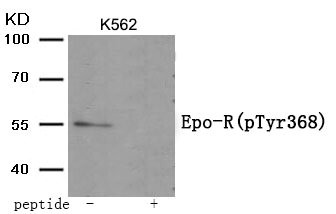
The antibody against EPOR was raised in rabbit using the Peptide sequence around phosphorylation site of Tyrosine 368 (D-T-Y(p)-L-V) derived from Human Epo-R. as the immunogen. Antibodies were produced by immunizing rabbits with synthetic phosphopeptide and KLH conjugates. Antibodies were purified by affinity-chromatography using epitope-specific phosphopeptide. Non-phospho specific antibodies were removed by chromatogramphy usi This antibody has been validated on ELISA, WB.
$360.00
| Cat.No | ADC-42809A | Clonality | Polyclonal |
|---|---|---|---|
| Host Species | Rabbit | Target Name | EPOR |
| Target Synonyms | EPOR; Erythropoietin receptor; EPO-R | Form | Liquid |
| Species Reactivity | Human, Mouse, Rat | Storage Buffer | PH 7.4, 0.02% sodium azide and 50% glycerol., 150mM NaCl, Rabbit IgG in phosphate buffered saline (without Mg2+ and Ca2+) |
| Application | ELISA, WB | Storage | Upon receipt |
| Immunogen Description | Peptide sequence around phosphorylation site of Tyrosine 368 (D-T-Y(p)-L-V) derived from Human Epo-R. | Target Species | Human |
|---|---|---|---|
| Immunogen Sequence | Complete sequences for the immunogen, target protein, and peptides are available upon request. | Uniprot ID | P19235 |
Uniprot Id
P19235
Target Species
Human
Target Name
EPOR
Target Full Name
Erythropoietin receptor
Target Function
Receptor for erythropoietin. Mediates erythropoietin-induced erythroblast proliferation and differentiation. Upon EPO stimulation, EPOR dimerizes triggering the JAK2/STAT5 signaling cascade. In some cell types, can also activate STAT1 and STAT3. May also activate the LYN tyrosine kinase.; Isoform EPOR-T acts as a dominant-negative receptor of EPOR-mediated signaling.
Target Involvement
Erythrocytosis, familial, 1 (ECYT1)
Target Subcellular Location
Cell membrane; Single-pass type I membrane protein.; [Isoform EPOR-S]: Secreted. Note=Secreted and located to the cell surface.
Target Protein Families
Type I cytokine receptor family, Type 1 subfamily
Target Tissue Specificity
Erythroid cells and erythroid progenitor cells. Isoform EPOR-F is the most abundant form in EPO-dependent erythroleukemia cells and in late-stage erythroid progenitors. Isoform EPOR-S and isoform EPOR-T are the predominant forms in bone marrow. Isoform EP
Target Research Area
Cardiovascular
Target Synonyms
EPOR; Erythropoietin receptor; EPO-R
Target Background
This gene encodes the erythropoietin receptor which is a member of the cytokine receptor family. Upon erythropoietin binding, this receptor activates Jak2 tyrosine kinase which activates different intracellular pathways including: Ras/MAP kinase, phosphatidylinositol 3-kinase and STAT transcription factors. The stimulated erythropoietin receptor appears to have a role in erythroid cell survival. Defects in the erythropoietin receptor may produce erythroleukemia and familial erythrocytosis. Dysregulation of this gene may affect the growth of certain tumors. Alternate splicing results in multiple transcript variants.
Notification