• Contact info@abtriva.com for inquiries and orders.
  • Chinese (Simplified)

  • English

  • German

  • Korean

  • Spanish

United States (English / $ USD)

Rabbit anti-Human KCNN3 Polyclonal Antibody

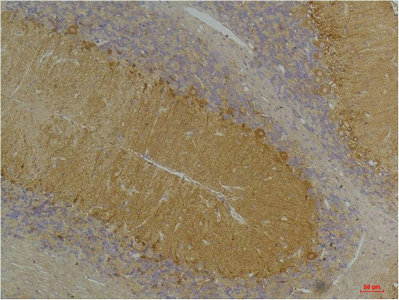
The antibody against KCNN3 was raised in rabbit using the Synthetic Peptide as the immunogen. This antibody exists as a non-conjugated antibody. The antibody was affinity-purified from rabbit antiserum by affinity-chromatography using specific immunogen. This antibody has been validated on IHC, ELISA.

ADC-13177A

The antibody against KCNN3 was raised in rabbit using the Synthetic Peptide as the immunogen. This antibody exists as a non-conjugated antibody. The antibody was affinity-purified from rabbit antiserum by affinity-chromatography using specific immunogen. This antibody has been validated on IHC, ELISA.

$167.00

Number
Order Exclusive Products Now

Request a Quote
High Purity LevelsPrecision and ReliabilityCustomization Options

Specifications


Cat.No ADC-13177A ClonalityPolyclonal
Host SpeciesRabbitTarget NameKCNN3
Target SynonymsKCNN3; K3; Small conductance calcium-activated potassium channel protein 3; SK3; SKCa 3; SKCa3; KCa2.3FormLiquid
Species ReactivityHuman, RatStorage Buffer0.5% BSA and 0.02% sodium azide., Liquid in PBS containing 50% glycerol
Purification MethodThe antibody was affinity-purified from rabbit antiserum by affinity-chromatography using specific immunogen.ConjugateNon-conjugated
ApplicationELISA, IHCStorageUpon receipt

Immunogen Information


Immunogen DescriptionSynthetic PeptideTarget SpeciesHuman
Immunogen SequenceComplete sequences for the immunogen, target protein, and peptides are available upon request.Uniprot IDQ9UGI6
Background Information
  • Uniprot Id

    Q9UGI6

  • Target Species

    Human

  • Target Name

    KCNN3

  • Target Full Name

    Small conductance calcium-activated potassium channel protein 3

  • Target Function

    Forms a voltage-independent potassium channel activated by intracellular calcium. Activation is followed by membrane hyperpolarization. Thought to regulate neuronal excitability by contributing to the slow component of synaptic afterhyperpolarization.

  • Target Subcellular Location

    Membrane; Multi-pass membrane protein.

  • Target Protein Families

    Potassium channel KCNN family, KCa2.3/KCNN3 subfamily

  • Target Synonyms

    KCNN3; K3; Small conductance calcium-activated potassium channel protein 3; SK3; SKCa 3; SKCa3; KCa2.3

  • Target Background

    Action potentials in vertebrate neurons are followed by an afterhyperpolarization (AHP) that may persist for several seconds and may have profound consequences for the firing pattern of the neuron. Each component of the AHP is kinetically distinct and is mediated by different calcium-activated potassium channels. This gene belongs to the KCNN family of potassium channels. It encodes an integral membrane protein that forms a voltage-independent calcium-activated channel, which is thought to regulate neuronal excitability by contributing to the slow component of synaptic AHP. This gene contains two CAG repeat regions in the coding sequence. It was thought that expansion of one or both of these repeats could lead to an increased susceptibility to schizophrenia or bipolar disorder, but studies indicate that this is probably not the case. Alternatively spliced transcript variants encoding different isoforms have been found for this gene.

Inquire Rabbit anti-Human KCNN3 Polyclonal Antibody Now


AbTriva respects your privacy and protects your personal data in accordance with AbTriva. For more information, please see our data protection statement. *

Notification