-
Chinese (Simplified)
-
English
-
German
-
Korean
-
Spanish

Chinese (Simplified)
English
German
Korean
Spanish
Sign up for an account to enjoy easy online shopping and instant order tracking.
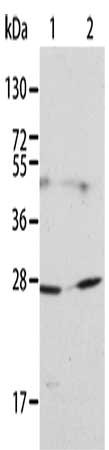
The antibody against KLK15 was raised in rabbit using the Fusion protein of Human KLK15 as the immunogen. This antibody exists as a non-conjugated isotype IgG, Antigen affinity purified. This antibody has been validated on ELISA, WB, IHC.
$299.00
| Cat.No | ADC-31739A | Clonality | Polyclonal |
|---|---|---|---|
| Host Species | Rabbit | Target Name | KLK15 |
| Target Synonyms | KLK15 antibody; Kallikrein-15 antibody; EC 3.4.21.- antibody; ACO protease antibody | Form | Liquid |
| Species Reactivity | Human | Isotype | IgG |
| Storage Buffer | 0.05% NaN3, 40% Glycerol., pH7.4 PBS | Purification Method | Antigen affinity purified |
| Conjugate | Non-conjugated | Application | ELISA, IHC, WB |
| Storage | Upon receipt |
| Immunogen Description | Fusion protein of Human KLK15 | Target Species | Human |
|---|---|---|---|
| Immunogen Sequence | Complete sequences for the immunogen, target protein, and peptides are available upon request. | Uniprot ID | Q9H2R5 |
Uniprot Id
Q9H2R5
Target Species
Human
Target Name
KLK15
Target Full Name
Kallikrein-15
Target Function
Protease whose physiological substrate is not yet known.
Target Subcellular Location
Secreted.
Target Protein Families
Peptidase S1 family, Kallikrein subfamily
Target Tissue Specificity
Highest expression in the thyroid gland. Also expressed in the prostate, salivary, and adrenal glands and in the colon testis and kidney.
Target Synonyms
KLK15; Kallikrein-15; EC 3.4.21.-; ACO protease
Target Background
Kallikreins are a subgroup of serine proteases having diverse physiological functions. Growing evidence suggests that many kallikreins are implicated in carcinogenesis and some have potential as novel cancer and other disease biomarkers. This gene is one of the fifteen kallikrein subfamily members located in a cluster on chromosome 19. In prostate cancer, this gene has increased expression, which indicates its possible use as a diagnostic or prognostic marker for prostate cancer. The gene contains multiple polyadenylation sites and alternative splicing results in multiple transcript variants encoding distinct isoforms.
Notification