• Contact info@abtriva.com for inquiries and orders.
  • Chinese (Simplified)

  • English

  • German

  • Korean

  • Spanish

United States (English / $ USD)

Rabbit anti-Human Occludin Polyclonal Antibody

The antibody against Occludin was raised in Rabbit using the recombinant fusion protein containing a sequence corresponding to amino acids 400-522 of human Occludin (NP_002529.1) as the immunogen. The polyclonal antibody exists as a isotype IgG, by affinity purification. This antibody has been validated on WB, ELISA.

ADA-13141A

The antibody against Occludin was raised in Rabbit using the recombinant fusion protein containing a sequence corresponding to amino acids 400-522 of human Occludin (NP_002529.1) as the immunogen. The polyclonal antibody exists as a isotype IgG, by affinity purification. This antibody has been validated on WB, ELISA.

Number
Order Exclusive Products Now

Request a Quote
High Purity LevelsPrecision and ReliabilityCustomization Options

Specifications


Cat.No ADA-13141A ClonalityPolyclonal
Host SpeciesRabbitTarget NameOccludin
Target SynonymsBLCPMG; PTORCH1; PPP1R115; OccludinFormLiquid
Species ReactivityHuman, Mouse, RatIsotypeIgG
Storage Buffer50% Glycerol, PBS with 0.05% proclin300, pH7.3.Purification MethodAffinity purification
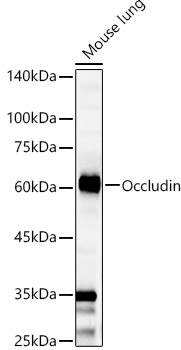
Positive SamplesMouse lungApplicationELISA, WB

Immunogen Information


Immunogen DescriptionRecombinant fusion protein containing a sequence corresponding to amino acids 400-522 of human Occludin (NP_002529.1).Target SpeciesHuman
Immunogen SequenceTDYTTGGESCDELEEDWIREYPPITSDQQRQLYKRNFDTGLQEYKSLQSELDEINKELSRLDKELDDYREESEEYMAAADEYNRLKQVKGSADYKSKKNHCKQLKSKLSHIKKMVGDYDRQKTUniprot IDQ16625
Background Information
  • Uniprot Id

    Q16625

  • Target Species

    Human

  • Target Name

    OCLN

  • Target Full Name

    Occludin

  • Target Function

    May play a role in the formation and regulation of the tight junction (TJ) paracellular permeability barrier. It is able to induce adhesion when expressed in cells lacking tight junctions.; (Microbial infection) Acts as a co-receptor for hepatitis C virus (HCV) in hepatocytes.

  • Target Involvement

    Pseudo-TORCH syndrome 1 (PTORCH1)

  • Target Subcellular Location

    Cell membrane; Multi-pass membrane protein. Cell junction, tight junction.

  • Target Protein Families

    ELL/occludin family

  • Target Tissue Specificity

    Localized at tight junctions of both epithelial and endothelial cells. Highly expressed in kidney. Not detected in testis.

  • Target Synonyms

    OCLN; Occludin

  • Target Background

    This gene encodes an integral membrane protein that is required for cytokine-induced regulation of the tight junction paracellular permeability barrier. Mutations in this gene are thought to be a cause of band-like calcification with simplified gyration and polymicrogyria (BLC-PMG), an autosomal recessive neurologic disorder that is also known as pseudo-TORCH syndrome. Alternative splicing results in multiple transcript variants. A related pseudogene is present 1.5 Mb downstream on the q arm of chromosome 5.

Inquire Rabbit anti-Human Occludin Polyclonal Antibody Now


AbTriva respects your privacy and protects your personal data in accordance with AbTriva. For more information, please see our data protection statement. *

Notification