• Contact info@abtriva.com for inquiries and orders.
  • Chinese (Simplified)

  • English

  • German

  • Korean

  • Spanish

United States (English / $ USD)

Rabbit anti-Human PDCD10 Polyclonal Antibody

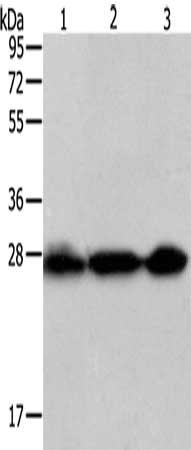
The antibody against PDCD10 was raised in rabbit using the Fusion protein of Human PDCD10 as the immunogen. This antibody exists as a non-conjugated isotype IgG, Antigen affinity purified. This antibody has been validated on ELISA, WB, IHC.

ADC-31518A

The antibody against PDCD10 was raised in rabbit using the Fusion protein of Human PDCD10 as the immunogen. This antibody exists as a non-conjugated isotype IgG, Antigen affinity purified. This antibody has been validated on ELISA, WB, IHC.

$299.00

Number
Order Exclusive Products Now

Request a Quote
High Purity LevelsPrecision and ReliabilityCustomization Options

Specifications


Cat.No ADC-31518A ClonalityPolyclonal
Host SpeciesRabbitTarget NamePDCD10
FormLiquidSpecies ReactivityHuman, Mouse, Rat
IsotypeIgGStorage Buffer0.05% NaN3, 40% Glycerol., pH7.4 PBS
Purification MethodAntigen affinity purifiedConjugateNon-conjugated
ApplicationELISA, IHC, WBStorageUpon receipt

Immunogen Information


Immunogen DescriptionFusion protein of Human PDCD10Target SpeciesHuman
Immunogen SequenceComplete sequences for the immunogen, target protein, and peptides are available upon request.Uniprot IDQ9BUL8
Background Information
  • Uniprot Id

    Q9BUL8

  • Target Species

    Human

  • Target Name

    PDCD10

  • Target Full Name

    Programmed cell death protein 10

  • Target Function

    Promotes cell proliferation. Modulates apoptotic pathways. Increases mitogen-activated protein kinase activity and STK26 activity. Important for cell migration, and for normal structure and assembly of the Golgi complex. Important for KDR/VEGFR2 signaling. Increases the stability of KDR/VEGFR2 and prevents its breakdown. Required for normal cardiovascular development. Required for normal angiogenesis, vasculogenesis and hematopoiesis during embryonic development.

  • Target Involvement

    Cerebral cavernous malformations 3 (CCM3)

  • Target Subcellular Location

    Cytoplasm. Golgi apparatus membrane; Peripheral membrane protein; Cytoplasmic side. Cell membrane; Peripheral membrane protein; Cytoplasmic side. Note=Partially co-localizes with endogenous PXN at the leading edges of migrating cells.

  • Target Protein Families

    PDCD10 family

  • Target Tissue Specificity

    Ubiquitous.

  • Target Research Area

    Signal Transduction

  • Target Synonyms

    Apoptosis related protein 15; CCM3; Cerebral cavernous malformations 3 protein; MGC1212; MGC24477; PDC10_HUMAN; PDCD 10; PDCD10; Programmed cell death 10; Programmed cell death protein 10; TF 1 cell apoptosis related protein 15; TF-1 cell apoptosis-related protein 15; TFAR15

  • Target Background

    This gene encodes an evolutionarily conserved protein associated with cell apoptosis. The protein interacts with the serine/threonine protein kinase MST4 to modulate the extracellular signal-regulated kinase (ERK) pathway. It also interacts with and is phosphoryated by serine/threonine kinase 25, and is thought to function in a signaling pathway essential for vascular developent. Mutations in this gene are one cause of cerebral cavernous malformations, which are vascular malformations that cause seizures and cerebral hemorrhages. Multiple alternatively spliced variants, encoding the same protein, have been identified.

Inquire Rabbit anti-Human PDCD10 Polyclonal Antibody Now


AbTriva respects your privacy and protects your personal data in accordance with AbTriva. For more information, please see our data protection statement. *

Notification