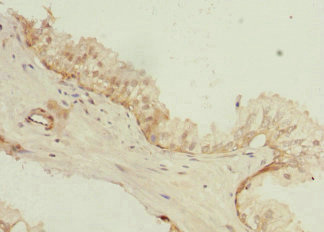
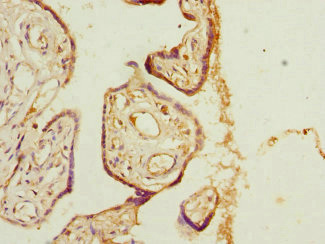
-
Chinese (Simplified)
-
English
-
German
-
Korean
-
Spanish
Chinese (Simplified)
English
German
Korean
Spanish
Sign up for an account to enjoy easy online shopping and instant order tracking.
The antibody against PHLDA2 was raised in rabbit using the Recombinant Human Pleckstrin homology-like domain family A member 2 protein (1-152AA) as the immunogen. This antibody exists as a non-conjugated isotype IgG, Antigen affinity purified. This antibody has been validated on ELISA, IHC.
$299.00
| Cat.No | ADC-17546A | Clonality | Polyclonal |
|---|---|---|---|
| Host Species | Rabbit | Target Name | PHLDA2 |
| Form | Liquid | Species Reactivity | Human |
| Isotype | IgG | Storage Buffer | 50% Glycerol, PBS with 0.02% sodium azide, pH7.3. |
| Purification Method | Antigen affinity purified | Conjugate | Non-conjugated |
| Application | ELISA, IHC | Storage | Upon receipt |
| Immunogen Description | Recombinant Human Pleckstrin homology-like domain family A member 2 protein (1-152AA) | Target Species | Human |
|---|---|---|---|
| Immunogen Sequence | Complete sequences for the immunogen, target protein, and peptides are available upon request. | Uniprot ID | Q53GA4 |
Uniprot Id
Q53GA4
Target Species
Human
Target Name
PHLDA2
Target Full Name
Pleckstrin homology-like domain family A member 2
Target Function
Plays a role in regulating placenta growth. May act via its PH domain that competes with other PH domain-containing proteins, thereby preventing their binding to membrane lipids.
Target Subcellular Location
Cytoplasm. Membrane; Peripheral membrane protein.
Target Protein Families
PHLDA2 family
Target Tissue Specificity
Expressed in placenta and adult prostate gland. In placenta, it is present in all cells of the villous cytotrophoblast. The protein is absent in cells from hydatidiform moles. Hydatidiform mole is a gestation characterized by abnormal development of both
Target Research Area
Cell Biology
Target Synonyms
Beckwith Wiedemann syndrome chromosome region 1 candidate protein C; Beckwith-Wiedemann syndrome chromosomal region 1 candidate gene C protein; BRW 1C; BRW1C; BWR 1C; BWR1C; HLDA 2; HLDA2; Imprinted in placenta and liver; Imprinted in placenta and liver protein; IPL; p17 Beckwith Wiedemann region 1C; p17 BWR1C; p17-Beckwith-Wiedemann region 1 C; p17-BWR1C; PHLA2_HUMAN; PHLDA 2; phlda2; Pleckstrin homology like domain family A member 2; Pleckstrin homology-like domain family A member 2; TSSC 3; Tumor suppressing STF cDNA 3 protein; Tumor suppressing subchromosomal transferable fragment candidate gene 3 protein; Tumor suppressing subchromosomal transferable fragment cDNA 3; Tumor suppressing subtransferable candidate 3; Tumor supressing STF cDNA 3; Tumor-suppressing STF cDNA 3 protein; Tumor-suppressing subchromosomal transferable fragment candidate gene 3 protein
Target Background
This gene is located in a cluster of imprinted genes on chromosome 11p15.5, which is considered to be an important tumor suppressor gene region. Alterations in this region may be associated with the Beckwith-Wiedemann syndrome, Wilms tumor, rhabdomyosarcoma, adrenocortical carcinoma, and lung, ovarian, and breast cancer. This gene has been shown to be imprinted, with preferential expression from the maternal allele in placenta and liver.
Notification