-
Chinese (Simplified)
-
English
-
German
-
Korean
-
Spanish
Chinese (Simplified)
English
German
Korean
Spanish
Sign up for an account to enjoy easy online shopping and instant order tracking.
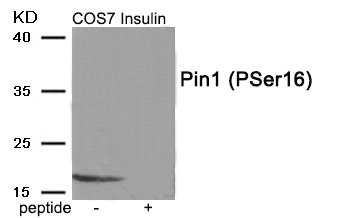
The antibody against PIN1 was raised in rabbit using the Peptide sequence around phosphorylation site of serine16(R-M-S(p)-R-S) derived from Human Pin1 . as the immunogen. Antibodies were produced by immunizing rabbits with synthetic phosphopeptide and KLH conjugates. Antibodies were purified by affinity-chromatography using epitope-specific phosphopeptide. Non-phospho specific antibodies were removed by chromatogramphy usi This antibody has been validated on ELISA, WB.
$360.00
| Cat.No | ADC-42840A | Clonality | Polyclonal |
|---|---|---|---|
| Host Species | Rabbit | Target Name | PIN1 |
| Target Synonyms | DOD antibody; DODO, Drosophila | Form | Liquid |
| Species Reactivity | Human, Mouse, Rat | Storage Buffer | PH 7.4, 0.02% sodium azide and 50% glycerol., 150mM NaCl, Rabbit IgG in phosphate buffered saline (without Mg2+ and Ca2+) |
| Application | ELISA, WB | Storage | Upon receipt |
| Immunogen Description | Peptide sequence around phosphorylation site of serine16(R-M-S(p)-R-S) derived from Human Pin1 . | Target Species | Human |
|---|---|---|---|
| Immunogen Sequence | Complete sequences for the immunogen, target protein, and peptides are available upon request. | Uniprot ID | Q13526 |
Uniprot Id
Q13526
Target Species
Human
Target Name
PIN1
Target Full Name
Peptidyl-prolyl cis-trans isomerase NIMA-interacting 1
Target Function
Peptidyl-prolyl cis/trans isomerase (PPIase) that binds to and isomerizes specific phosphorylated Ser/Thr-Pro (pSer/Thr-Pro) motifs. By inducing conformational changes in a subset of phosphorylated proteins, acts as a molecular switch in multiple cellular processes. Displays a preference for acidic residues located N-terminally to the proline bond to be isomerized. Regulates mitosis presumably by interacting with NIMA and attenuating its mitosis-promoting activity. Down-regulates kinase activity of BTK. Can transactivate multiple oncogenes and induce centrosome amplification, chromosome instability and cell transformation. Required for the efficient dephosphorylation and recycling of RAF1 after mitogen activation. Binds and targets PML and BCL6 for degradation in a phosphorylation-dependent manner. Acts as a regulator of JNK cascade by binding to phosphorylated FBXW7, disrupting FBXW7 dimerization and promoting FBXW7 autoubiquitination and degradation: degradation of FBXW7 leads to subsequent stabilization of JUN. May facilitate the ubiquitination and proteasomal degradation of RBBP8/CtIP through CUL3/KLHL15 E3 ubiquitin-protein ligase complex, hence favors DNA double-strand repair through error-prone non-homologous end joining (NHEJ) over error-free, RBBP8-mediated homologous recombination (HR). Upon IL33-induced lung inflammation, catalyzes cis-trans isomerization of phosphorylated IRAK3/IRAK-M, inducing IRAK3 stabilization, nuclear translocation and expression of pro-inflammatory genes in dendritic cells.
Target Subcellular Location
Nucleus. Nucleus speckle. Cytoplasm.
Target Tissue Specificity
Expressed in immune cells in the lung (at protein level). The phosphorylated form at Ser-71 is expressed in normal breast tissue cells but not in breast cancer cells.
Target Synonyms
DOD; DODO, Drosophila, homolog of; FLJ40239; FLJ77628; MGC10717; NIMA interacting 1; Peptidyl prolyl cis trans isomerase NIMA interacting 1; Peptidyl prolyl cis/trans isomerase NIMA interacting; Peptidyl-prolyl cis-trans isomerase NIMA-interacting 1; Peptidyl-prolyl cis-trans isomerase pin1; Peptidylprolyl cis/trans isomerase NIMA interacting 1; Pin 1; Pin1; PIN1_HUMAN; PPIase Pin1; Prolyl isomerase; Protein (peptidylprolyl cis/trans isomerase) NIMA interacting 1; Protein NIMA interacting 1; Rotamase Pin1; UBL 5; UBL5
Target Background
Peptidyl-prolyl cis/trans isomerases (PPIases) catalyze the cis/trans isomerization of peptidyl-prolyl peptide bonds. This gene encodes one of the PPIases, which specifically binds to phosphorylated ser/thr-pro motifs to catalytically regulate the post-phosphorylation conformation of its substrates. The conformational regulation catalyzed by this PPIase has a profound impact on key proteins involved in the regulation of cell growth, genotoxic and other stress responses, the immune response, induction and maintenance of pluripotency, germ cell development, neuronal differentiation, and survival. This enzyme also plays a key role in the pathogenesis of Alzheimer's disease and many cancers. Multiple alternatively spliced transcript variants have been found for this gene.
Notification