• Contact info@abtriva.com for inquiries and orders.
  • Chinese (Simplified)

  • English

  • German

  • Korean

  • Spanish

United States (English / $ USD)

Rabbit anti-Human POGLUT1 Polyclonal Antibody

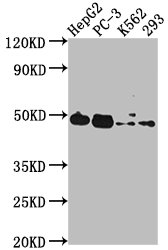
The antibody against POGLUT1 was raised in rabbit using the Recombinant Human Protein O-glucosyltransferase 1 protein (132-392AA) as the immunogen. This antibody exists as a non-conjugated isotype IgG, purified by protein G with a purity greater than 95%. This antibody has been validated on ELISA, WB, IHC.

ADC-00692A

The antibody against POGLUT1 was raised in rabbit using the Recombinant Human Protein O-glucosyltransferase 1 protein (132-392AA) as the immunogen. This antibody exists as a non-conjugated isotype IgG, purified by protein G with a purity greater than 95%. This antibody has been validated on ELISA, WB, IHC.

$299.00

Number
Order Exclusive Products Now

Request a Quote
High Purity LevelsPrecision and ReliabilityCustomization Options

Specifications


Cat.No ADC-00692A ClonalityPolyclonal
Host SpeciesRabbitTarget NamePOGLUT1
Target SynonymsC3orf9 antibody; CAP10 like 46 kDa protein antibody; CAP10 like proteinFormLiquid
Species ReactivityHumanIsotypeIgG
Storage Buffer0.01M PBS, 0.03% Proclin 300; Constituents: 50% Glycerol, PH 7.4Purification Method>95%, Protein G purified
ConjugateNon-conjugatedApplicationELISA, IHC, WB
StorageUpon receipt

Immunogen Information


Immunogen DescriptionRecombinant Human Protein O-glucosyltransferase 1 protein (132-392AA)Target SpeciesHuman
Immunogen SequenceComplete sequences for the immunogen, target protein, and peptides are available upon request.Uniprot IDQ8NBL1
Background Information
  • Uniprot Id

    Q8NBL1

  • Target Species

    Human

  • Target Name

    POGLUT1

  • Target Full Name

    Protein O-glucosyltransferase 1

  • Target Function

    Dual specificity glycosyltransferase that catalyzes the transfer of glucose and xylose from UDP-glucose and UDP-xylose, respectively, to a serine residue found in the consensus sequence of C-X-S-X-P-C. Specifically targets extracellular EGF repeats of protein such as CRB2, F7, F9 and NOTCH2. Acts as a positive regulator of Notch signaling by mediating O-glucosylation of Notch, leading to regulate muscle development. Notch glucosylation does not affect Notch ligand binding. Required during early development to promote gastrulation: acts by mediating O-glucosylation of CRB2, which is required for CRB2 localization to the cell membrane.

  • Target Involvement

    Dowling-Degos disease 4 (DDD4); Limb-girdle muscular dystrophy 2Z (LGMD2Z)

  • Target Subcellular Location

    Endoplasmic reticulum lumen.

  • Target Protein Families

    Glycosyltransferase 90 family

  • Target Tissue Specificity

    Expressed in most adult tissues at different intensities. Abundantly expressed in liver. Expressed also in brain, heart, skeletal muscle, spleen, kidney, placenta, lung and peripheral blood leukocyte. Not detectable in colon, thymus and small intestine. E

  • Target Synonyms

    C3orf9; CAP10 like 46 kDa protein ; CAP10 like protein, 46 kDa ; CAP10-like 46 kDa protein; CLP46; hCLP46; hRumi; KDELC family like 1 ; KDELCL1; KTEL (Lys Tyr Glu Leu) containing 1 ; KTEL motif containing protein 1 ; KTEL motif-containing protein 1; KTEL1; KTELC1; MDS010; MDSRP; Myelodysplastic syndromes relative protein; O-glucosyltransferase rumi homolog; PGLT1_HUMAN; Poglut1; protein O glucosyltransferase 1; Protein O-glucosyltransferase 1; Protein O-xylosyltransferase; Rumi; x 010 protein

  • Target Background

    This gene encodes a protein with both O-glucosyltransferase and O-xylosyltransferase activity which localizes to the lumen of the endoplasmic reticulum. This protein has a carboxy-terminal KTEL motif which is predicted to function as an endoplasmic reticulum retention signal. This gene is an essential regulator of Notch signalling and likely plays a role in cell fate and tissue formation during development. It may also play a role in the pathogenesis of leukemia. Mutations in this gene have been associated with the autosomal dominant genodermatosis Dowling-Degos disease 4. Alternative splicing results in multiple transcript variants.

Inquire Rabbit anti-Human POGLUT1 Polyclonal Antibody Now


AbTriva respects your privacy and protects your personal data in accordance with AbTriva. For more information, please see our data protection statement. *

Notification