• Contact info@abtriva.com for inquiries and orders.
  • Chinese (Simplified)

  • English

  • German

  • Korean

  • Spanish

United States (English / $ USD)

Rabbit anti-Human Raptor Polyclonal Antibody

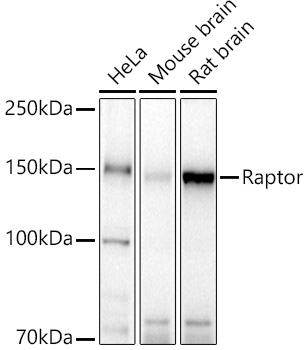
The antibody against Raptor was raised in Rabbit using the recombinant fusion protein containing a sequence corresponding to amino acids 888-1013 of human Raptor (NP_065812.1) as the immunogen. The polyclonal antibody exists as a isotype IgG, by affinity purification. This antibody has been validated on WB, ELISA.

ADA-07848A

The antibody against Raptor was raised in Rabbit using the recombinant fusion protein containing a sequence corresponding to amino acids 888-1013 of human Raptor (NP_065812.1) as the immunogen. The polyclonal antibody exists as a isotype IgG, by affinity purification. This antibody has been validated on WB, ELISA.

Number
Order Exclusive Products Now

Request a Quote
High Purity LevelsPrecision and ReliabilityCustomization Options

Specifications


Cat.No ADA-07848A ClonalityPolyclonal
Host SpeciesRabbitTarget NameRaptor
Target SynonymsKOG1; Mip1; RaptorFormLiquid
Species ReactivityHuman, Mouse, RatIsotypeIgG
Storage Buffer50% Glycerol, PBS with 0.05% proclin300, pH7.3.Purification MethodAffinity purification
Positive SamplesHeLa, Rat brain, Mouse brainApplicationELISA, WB

Immunogen Information


Immunogen DescriptionRecombinant fusion protein containing a sequence corresponding to amino acids 888-1013 of human Raptor (NP_065812.1).Target SpeciesHuman
Immunogen SequenceLTNDVAKQPVSRDLPSGRPGTTGPAGAQYTPHSHQFPRTRKMFDKGPEQTADDADDAAGHKSFISATVQTGFCDWSARYFAQPVMKIPEEHDLESQIRKEREWRFLRNSRVRRQAQQVIQKGITRLUniprot IDQ8N122
Background Information
  • Uniprot Id

    Q8N122

  • Target Species

    Human

  • Target Name

    RPTOR

  • Target Full Name

    Regulatory-associated protein of mTOR

  • Target Function

    Involved in the control of the mammalian target of rapamycin complex 1 (mTORC1) activity which regulates cell growth and survival, and autophagy in response to nutrient and hormonal signals; functions as a scaffold for recruiting mTORC1 substrates. mTORC1 is activated in response to growth factors or amino acids. Growth factor-stimulated mTORC1 activation involves a AKT1-mediated phosphorylation of TSC1-TSC2, which leads to the activation of the RHEB GTPase that potently activates the protein kinase activity of mTORC1. Amino acid-signaling to mTORC1 requires its relocalization to the lysosomes mediated by the Ragulator complex and the Rag GTPases. Activated mTORC1 up-regulates protein synthesis by phosphorylating key regulators of mRNA translation and ribosome synthesis. mTORC1 phosphorylates EIF4EBP1 and releases it from inhibiting the elongation initiation factor 4E (eiF4E). mTORC1 phosphorylates and activates S6K1 at 'Thr-389', which then promotes protein synthesis by phosphorylating PDCD4 and targeting it for degradation. Involved in ciliogenesis. mTORC1 complex in excitatory neuronal transmission is required for the prosocial behavior induced by the psychoactive substance lysergic acid diethylamide (LSD).

  • Target Subcellular Location

    Cytoplasm. Lysosome. Cytoplasmic granule. Note=Targeting to lysosomes depends on amino acid availability. In arsenite-stressed cells, accumulates in stress granules when associated with SPAG5 and association with lysosomes is drastically decreased.

  • Target Protein Families

    WD repeat RAPTOR family

  • Target Tissue Specificity

    Highly expressed in skeletal muscle, and in a lesser extent in brain, lung, small intestine, kidney and placenta. Isoform 3 is widely expressed, with highest levels in nasal mucosa and pituitary and lowest in spleen.

  • Target Synonyms

    KIAA1303; KOG1; Mip1; P150 target of rapamycin (TOR) scaffold protein ; p150 target of rapamycin (TOR) scaffold protein containing WD repeats; P150 target of rapamycin (TOR)-scaffold protein; Raptor; Regulatory associated protein of mTOR; Regulatory associated protein of MTOR complex 1; Regulatory-associated protein of mTOR; RPTOR; RPTOR_HUMAN

  • Target Background

    This gene encodes a component of a signaling pathway that regulates cell growth in response to nutrient and insulin levels. The encoded protein forms a stoichiometric complex with the mTOR kinase, and also associates with eukaryotic initiation factor 4E-binding protein-1 and ribosomal protein S6 kinase. The protein positively regulates the downstream effector ribosomal protein S6 kinase, and negatively regulates the mTOR kinase. Multiple transcript variants encoding different isoforms have been found for this gene.

Inquire Rabbit anti-Human Raptor Polyclonal Antibody Now


AbTriva respects your privacy and protects your personal data in accordance with AbTriva. For more information, please see our data protection statement. *

Notification