-
Chinese (Simplified)
-
English
-
German
-
Korean
-
Spanish
Chinese (Simplified)
English
German
Korean
Spanish
Sign up for an account to enjoy easy online shopping and instant order tracking.
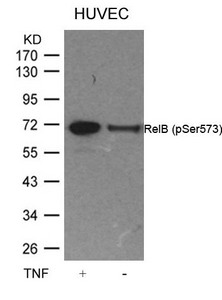
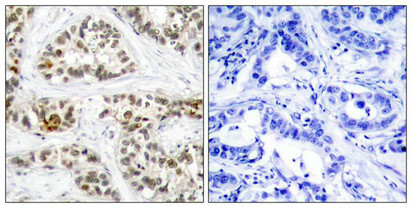
The antibody against RELB was raised in rabbit using the Peptide sequence around phosphorylation site of serine 573 (L-L-S(p)-P-G) derived from Human RelB. as the immunogen. Antibodies were produced by immunizing rabbits with synthetic phosphopeptide and KLH conjugates. Antibodies were purified by affinity-chromatography using epitope-specific phosphopeptide. Non-phospho specific antibodies were removed by chromatogramphy usi This antibody has been validated on ELISA, WB, IHC.
$360.00
| Cat.No | ADC-43643A | Clonality | Polyclonal |
|---|---|---|---|
| Host Species | Rabbit | Target Name | RELB |
| Form | Liquid | Species Reactivity | Human, Mouse |
| Storage Buffer | PH 7.4, 0.02% sodium azide and 50% glycerol., 150mM NaCl, Supplied at 1.0mg/mL in phosphate buffered saline (without Mg2+ and Ca2+) | Application | ELISA, IHC, WB |
| Storage | Upon receipt |
| Immunogen Description | Peptide sequence around phosphorylation site of serine 573 (L-L-S(p)-P-G) derived from Human RelB. | Target Species | Human |
|---|---|---|---|
| Immunogen Sequence | Complete sequences for the immunogen, target protein, and peptides are available upon request. | Uniprot ID | Q01201 |
Uniprot Id
Q01201
Target Species
Human
Target Name
RELB
Target Full Name
Transcription factor RelB
Target Function
NF-kappa-B is a pleiotropic transcription factor which is present in almost all cell types and is involved in many biological processed such as inflammation, immunity, differentiation, cell growth, tumorigenesis and apoptosis. NF-kappa-B is a homo- or heterodimeric complex formed by the Rel-like domain-containing proteins RELA/p65, RELB, NFKB1/p105, NFKB1/p50, REL and NFKB2/p52. The dimers bind at kappa-B sites in the DNA of their target genes and the individual dimers have distinct preferences for different kappa-B sites that they can bind with distinguishable affinity and specificity. Different dimer combinations act as transcriptional activators or repressors, respectively. NF-kappa-B is controlled by various mechanisms of post-translational modification and subcellular compartmentalization as well as by interactions with other cofactors or corepressors. NF-kappa-B complexes are held in the cytoplasm in an inactive state complexed with members of the NF-kappa-B inhibitor (I-kappa-B) family. In a conventional activation pathway, I-kappa-B is phosphorylated by I-kappa-B kinases (IKKs) in response to different activators, subsequently degraded thus liberating the active NF-kappa-B complex which translocates to the nucleus. NF-kappa-B heterodimeric RelB-p50 and RelB-p52 complexes are transcriptional activators. RELB neither associates with DNA nor with RELA/p65 or REL. Stimulates promoter activity in the presence of NFKB2/p49. As a member of the NUPR1/RELB/IER3 survival pathway, may provide pancreatic ductal adenocarcinoma with remarkable resistance to cell stress, such as starvation or gemcitabine treatment. Regulates the circadian clock by repressing the transcriptional activator activity of the CLOCK-ARNTL/BMAL1 heterodimer in a CRY1/CRY2 independent manner. Increased repression of the heterodimer is seen in the presence of NFKB2/p52. Is required for both T and B lymphocyte maturation and function.
Target Involvement
Immunodeficiency 53 (IMD53)
Target Subcellular Location
Nucleus. Cytoplasm, cytoskeleton, microtubule organizing center, centrosome. Note=Colocalizes with NEK6 in the centrosome.
Target Synonyms
IREL; I-REL; IMD53; REL-B; Phospho-RELB-S573
Target Background
Enables RNA polymerase II cis-regulatory region sequence-specific DNA binding activity and protein kinase binding activity. Involved in lymphocyte differentiation and negative regulation of interferon-beta production. Located in cytosol and nucleoplasm. Part of chromatin; nucleus; and transcription repressor complex. Colocalizes with centrosome. Implicated in breast cancer and immunodeficiency 53. Biomarker of breast cancer and transitional cell carcinoma.
Notification