-
Chinese (Simplified)
-
English
-
German
-
Korean
-
Spanish
Chinese (Simplified)
English
German
Korean
Spanish
Sign up for an account to enjoy easy online shopping and instant order tracking.
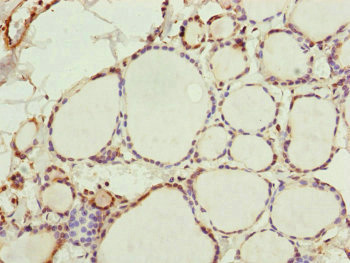
The antibody against RNF114 was raised in rabbit using the Recombinant Human E3 ubiquitin-protein ligase RNF114 protein (1-228AA) as the immunogen. This antibody exists as a non-conjugated isotype IgG, Antigen affinity purified. This antibody has been validated on ELISA, WB, IHC.
$299.00
| Cat.No | ADC-16599A | Clonality | Polyclonal |
|---|---|---|---|
| Host Species | Rabbit | Target Name | RNF114 |
| Form | Liquid | Species Reactivity | Human, Mouse |
| Isotype | IgG | Storage Buffer | 50% Glycerol, PBS with 0.02% sodium azide, pH7.3. |
| Purification Method | Antigen affinity purified | Conjugate | Non-conjugated |
| Application | ELISA, IHC, WB | Storage | Upon receipt |
| Immunogen Description | Recombinant Human E3 ubiquitin-protein ligase RNF114 protein (1-228AA) | Target Species | Human |
|---|---|---|---|
| Immunogen Sequence | Complete sequences for the immunogen, target protein, and peptides are available upon request. | Uniprot ID | Q9Y508 |
Uniprot Id
Q9Y508
Target Species
Human
Target Name
RNF114
Target Full Name
E3 ubiquitin-protein ligase RNF114
Target Function
E3 ubiquitin-protein ligase that promotes the ubiquitination of various substrates. In turn, participates in the regulation of many biological processes including cell cycle, apoptosis, osteoclastogenesis as well as innate or adaptive immunity. Acts as negative regulator of NF-kappa-B-dependent transcription by promoting the ubiquitination and stabilization of the NF-kappa-B inhibitor TNFAIP3. May promote the ubiquitination of TRAF6 as well. Acts also as a negative regulator of T-cell activation. Inhibits cellular dsRNA responses and interferon production by targeting MAVS component for proteasomal degradation. Ubiquitinates the CDK inhibitor CDKN1A leading to its degradationand probably also CDKN1B and CDKN1C. This activity stimulates cell cycle G1-to-S phase transition and suppresses cellular senescence. May play a role in spermatogenesis.
Target Subcellular Location
Cytoplasm. Nucleus.
Target Tissue Specificity
Expressed in numerous tissues, including skin, CD4 lymphocytes and dendritic cells. Highest levels in testis.
Target Research Area
Epigenetics and Nuclear Signaling
Target Synonyms
1110008J21Rik; AI225886; AW549494; MGC112560; OTTMUSP00000001082; OTTMUSP00000017392; PSORS12; RING finger protein 114; RN114_HUMAN; RNF114; RP23-118A2.1; Zfp228; Zfp313; Zinc finger protein 228; Zinc finger protein 313; ZNF228; ZNF313
Target Background
Predicted to enable ubiquitin protein ligase activity. Predicted to be involved in protein polyubiquitination and ubiquitin-dependent protein catabolic process. Located in cytosol and plasma membrane. Biomarker of male infertility.
Notification