-
Chinese (Simplified)
-
English
-
German
-
Korean
-
Spanish
Chinese (Simplified)
English
German
Korean
Spanish
Sign up for an account to enjoy easy online shopping and instant order tracking.
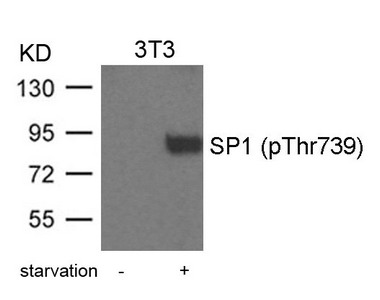
The antibody against SP1 was raised in rabbit using the Peptide sequence around phosphorylation site of threonine 739 (T-A-T(p)-P-S) derived from Human SP1 as the immunogen. Antibodies were produced by immunizing rabbits with synthetic phosphopeptide and KLH conjugates. Antibodies were purified by affinity-chromatography using epitope-specific phosphopeptide. Non-phospho specific antibodies were removed by chromatogramphy usi This antibody has been validated on ELISA, WB.
$360.00
| Cat.No | ADC-43236A | Clonality | Polyclonal |
|---|---|---|---|
| Host Species | Rabbit | Target Name | SP1 |
| Target Synonyms | SP 1 antibody; SP1 antibody; Sp1 transcription factor antibody; SP1_HUMAN antibody; Specificity protein 1 antibody; Transcription factor Sp1 antibody; TSFP 1 antibody; TSFP1 antibody | Form | Liquid |
| Species Reactivity | Human, Rat | Storage Buffer | PH 7.4, 0.02% sodium azide and 50% glycerol., 150mM NaCl, Supplied at 1.0mg/mL in phosphate buffered saline (without Mg2+ and Ca2+) |
| Application | ELISA, WB | Storage | Upon receipt |
| Immunogen Description | Peptide sequence around phosphorylation site of threonine 739 (T-A-T(p)-P-S) derived from Human SP1 | Target Species | Human |
|---|---|---|---|
| Immunogen Sequence | Complete sequences for the immunogen, target protein, and peptides are available upon request. | Uniprot ID | P08047 |
Uniprot Id
P08047
Target Species
Human
Target Name
SP1
Target Full Name
Transcription factor Sp1
Target Function
Transcription factor that can activate or repress transcription in response to physiological and pathological stimuli. Binds with high affinity to GC-rich motifs and regulates the expression of a large number of genes involved in a variety of processes such as cell growth, apoptosis, differentiation and immune responses. Highly regulated by post-translational modifications (phosphorylations, sumoylation, proteolytic cleavage, glycosylation and acetylation). Binds also the PDGFR-alpha G-box promoter. May have a role in modulating the cellular response to DNA damage. Implicated in chromatin remodeling. Plays an essential role in the regulation of FE65 gene expression. In complex with ATF7IP, maintains telomerase activity in cancer cells by inducing TERT and TERC gene expression. Isoform 3 is a stronger activator of transcription than isoform 1. Positively regulates the transcription of the core clock component ARNTL/BMAL1. Plays a role in the recruitment of SMARCA4/BRG1 on the c-FOS promoter. Plays a role in protecting cells against oxidative stress following brain injury by regulating the expression of RNF112.
Target Subcellular Location
Nucleus. Cytoplasm. Note=Nuclear location is governed by glycosylated/phosphorylated states. Insulin promotes nuclear location, while glucagon favors cytoplasmic location.
Target Protein Families
Sp1 C2H2-type zinc-finger protein family
Target Tissue Specificity
Up-regulated in adenocarcinomas of the stomach (at protein level). Isoform 3 is ubiquitously expressed at low levels.
Target Synonyms
SP 1; SP1; Sp1 transcription factor; SP1_HUMAN; Specificity protein 1; Transcription factor Sp1; TSFP 1; TSFP1
Target Background
The protein encoded by this gene is a zinc finger transcription factor that binds to GC-rich motifs of many promoters. The encoded protein is involved in many cellular processes, including cell differentiation, cell growth, apoptosis, immune responses, response to DNA damage, and chromatin remodeling. Post-translational modifications such as phosphorylation, acetylation, glycosylation, and proteolytic processing significantly affect the activity of this protein, which can be an activator or a repressor. Three transcript variants encoding different isoforms have been found for this gene.
Notification