-
Chinese (Simplified)
-
English
-
German
-
Korean
-
Spanish

Chinese (Simplified)
English
German
Korean
Spanish
Sign up for an account to enjoy easy online shopping and instant order tracking.
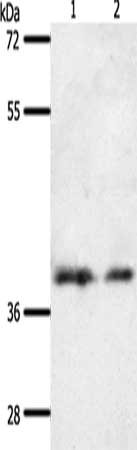
The antibody against SSTR1 was raised in rabbit using the Synthetic peptide of Human SSTR1 as the immunogen. This antibody exists as a non-conjugated isotype IgG, Antigen affinity purified. This antibody has been validated on ELISA, WB, IHC.
$299.00
| Cat.No | ADC-27453A | Clonality | Polyclonal |
|---|---|---|---|
| Host Species | Rabbit | Target Name | SSTR1 |
| Target Synonyms | SSTR1; Somatostatin receptor type 1; SS-1-R; SS1-R; SS1R; SRIF-2 | Form | Liquid |
| Species Reactivity | Human, Mouse, Rat | Isotype | IgG |
| Storage Buffer | 0.05% NaN3, 40% Glycerol., pH7.4 PBS | Purification Method | Antigen affinity purified |
| Conjugate | Non-conjugated | Application | ELISA, IHC, WB |
| Storage | Upon receipt |
| Immunogen Description | Synthetic peptide of Human SSTR1 | Target Species | Human |
|---|---|---|---|
| Immunogen Sequence | Complete sequences for the immunogen, target protein, and peptides are available upon request. | Uniprot ID | P30872 |
Uniprot Id
P30872
Target Species
Human
Target Name
SSTR1
Target Full Name
Somatostatin receptor type 1
Target Function
Receptor for somatostatin with higher affinity for somatostatin-14 than -28. This receptor is coupled via pertussis toxin sensitive G proteins to inhibition of adenylyl cyclase. In addition it stimulates phosphotyrosine phosphatase and Na(+)/H(+) exchanger via pertussis toxin insensitive G proteins.
Target Subcellular Location
Cell membrane; Multi-pass membrane protein.
Target Protein Families
G-protein coupled receptor 1 family
Target Tissue Specificity
Fetal kidney, fetal liver, and adult pancreas, brain, lung, jejunum and stomach.
Target Synonyms
SSTR1; Somatostatin receptor type 1; SS-1-R; SS1-R; SS1R; SRIF-2
Target Background
Somatostatins are peptide hormones that regulate diverse cellular functions such as neurotransmission, cell proliferation, and endocrine signaling as well as inhibiting the release of many hormones and other secretory proteins. Somatostatin has two active forms of 14 and 28 amino acids. The biological effects of somatostatins are mediated by a family of G-protein coupled somatostatin receptors that are expressed in a tissue-specific manner. The protein encoded by this gene is a member of the superfamily of somatostatin receptors having seven transmembrane segments. Somatostatin receptors form homodimers and heterodimers with other members of the superfamily as well as with other G-protein coupled receptors and receptor tyrosine kinases. This somatostatin receptor has greater affinity for somatostatin-14 than -28.
Notification