-
Chinese (Simplified)
-
English
-
German
-
Korean
-
Spanish
Chinese (Simplified)
English
German
Korean
Spanish
Sign up for an account to enjoy easy online shopping and instant order tracking.
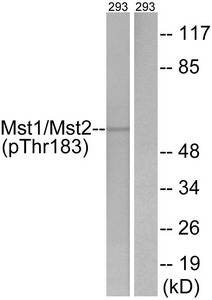
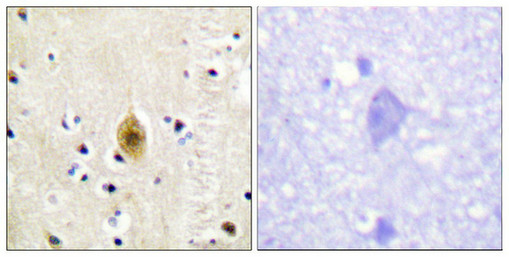
The antibody against STK4 was raised in rabbit using the Peptide sequence around phosphorylation site of threonine 183 (R-N-T(p)-V-I) derived from Human Mst1/2. as the immunogen. Antibodies were produced by immunizing rabbits with synthetic phosphopeptide and KLH conjugates. Antibodies were purified by affinity-chromatography using epitope-specific phosphopeptide. Non-phospho specific antibodies were removed by chromatogramphy usi This antibody has been validated on ELISA, WB, IHC.
$360.00
| Cat.No | ADC-40554A | Clonality | Polyclonal |
|---|---|---|---|
| Host Species | Rabbit | Target Name | STK4 |
| Form | Liquid | Species Reactivity | Human, Mouse |
| Storage Buffer | PH 7.4, 0.02% sodium azide and 50% glycerol., 150mM NaCl, Rabbit IgG in phosphate buffered saline (without Mg2+ and Ca2+) | Application | ELISA, IHC, WB |
| Storage | Upon receipt |
| Immunogen Description | Peptide sequence around phosphorylation site of threonine 183 (R-N-T(p)-V-I) derived from Human Mst1/2. | Target Species | Human |
|---|---|---|---|
| Immunogen Sequence | Complete sequences for the immunogen, target protein, and peptides are available upon request. | Uniprot ID | Q13043 |
Uniprot Id
Q13043
Target Species
Human
Target Name
STK4
Target Full Name
Serine/threonine-protein kinase 4
Target Function
Stress-activated, pro-apoptotic kinase which, following caspase-cleavage, enters the nucleus and induces chromatin condensation followed by internucleosomal DNA fragmentation. Key component of the Hippo signaling pathway which plays a pivotal role in organ size control and tumor suppression by restricting proliferation and promoting apoptosis. The core of this pathway is composed of a kinase cascade wherein STK3/MST2 and STK4/MST1, in complex with its regulatory protein SAV1, phosphorylates and activates LATS1/2 in complex with its regulatory protein MOB1, which in turn phosphorylates and inactivates YAP1 oncoprotein and WWTR1/TAZ. Phosphorylation of YAP1 by LATS2 inhibits its translocation into the nucleus to regulate cellular genes important for cell proliferation, cell death, and cell migration. STK3/MST2 and STK4/MST1 are required to repress proliferation of mature hepatocytes, to prevent activation of facultative adult liver stem cells (oval cells), and to inhibit tumor formation. Phosphorylates 'Ser-14' of histone H2B (H2BS14ph) during apoptosis. Phosphorylates FOXO3 upon oxidative stress, which results in its nuclear translocation and cell death initiation. Phosphorylates MOBKL1A, MOBKL1B and RASSF2. Phosphorylates TNNI3 (cardiac Tn-I) and alters its binding affinity to TNNC1 (cardiac Tn-C) and TNNT2 (cardiac Tn-T). Phosphorylates FOXO1 on 'Ser-212' and regulates its activation and stimulates transcription of PMAIP1 in a FOXO1-dependent manner. Phosphorylates SIRT1 and inhibits SIRT1-mediated p53/TP53 deacetylation, thereby promoting p53/TP53 dependent transcription and apoptosis upon DNA damage. Acts as an inhibitor of PKB/AKT1. Phosphorylates AR on 'Ser-650' and suppresses its activity by intersecting with PKB/AKT1 signaling and antagonizing formation of AR-chromatin complexes.
Target Involvement
T-cell immunodeficiency, recurrent infections, and autoimmunity with or without cardiac malformations (TIIAC)
Target Subcellular Location
Cytoplasm. Nucleus. Note=The caspase-cleaved form cycles between the nucleus and cytoplasm.
Target Protein Families
Protein kinase superfamily, STE Ser/Thr protein kinase family, STE20 subfamily
Target Tissue Specificity
Expressed in prostate cancer and levels increase from the normal to the malignant state (at protein level). Ubiquitously expressed.
Target Synonyms
Kinase responsive to stress; Krs2; Mammalian STE20 like protein kinase 1; Mammalian STE20-like protein kinase 1; Mammalian sterile 20 like 1; MST-1; MST1; Serine/threonine kinase 4; Serine/threonine protein kinase Krs 2; Serine/threonine-protein kinase 4; Serine/threonine-protein kinase Krs-2; STE20 like kinase MST1; STE20-like kinase MST1; STK4; STK4_HUMAN; TIIAC; YSK3
Target Background
The protein encoded by this gene is a cytoplasmic kinase that is structurally similar to the yeast Ste20p kinase, which acts upstream of the stress-induced mitogen-activated protein kinase cascade. The encoded protein can phosphorylate myelin basic protein and undergoes autophosphorylation. A caspase-cleaved fragment of the encoded protein has been shown to be capable of phosphorylating histone H2B. The particular phosphorylation catalyzed by this protein has been correlated with apoptosis, and it's possible that this protein induces the chromatin condensation observed in this process.
Notification