-
Chinese (Simplified)
-
English
-
German
-
Korean
-
Spanish
Chinese (Simplified)
English
German
Korean
Spanish
Sign up for an account to enjoy easy online shopping and instant order tracking.
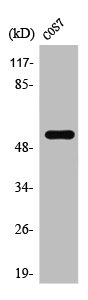
The antibody against TADA2A was raised in rabbit using the Synthesized peptide derived from the Internal region of Human TADA2L. as the immunogen. This antibody exists as a non-conjugated isotype IgG. The antibody was affinity-purified from rabbit antiserum by affinity-chromatography using epitope-specific immunogen. This antibody has been validated on WB, ELISA.
$167.00
| Cat.No | ADC-37518A | Clonality | Polyclonal |
|---|---|---|---|
| Host Species | Rabbit | Target Name | TADA2A |
| Target Synonyms | TADA2A antibody; TADA2L antibody; KL04P antibody; Transcriptional adapter 2-alpha antibody; Transcriptional adapter 2-like antibody; ADA2-like protein antibody | Form | Liquid |
| Species Reactivity | Human, Mouse, Rat, Monkey | Isotype | IgG |
| Storage Buffer | 0.5% BSA and 0.02% sodium azide., Liquid in PBS containing 50% glycerol | Purification Method | The antibody was affinity-purified from rabbit antiserum by affinity-chromatography using epitope-specific immunogen. |
| Conjugate | Non-conjugated | Application | ELISA, WB |
| Storage | Upon receipt |
| Immunogen Description | Synthesized peptide derived from the Internal region of Human TADA2L. | Target Species | Human |
|---|---|---|---|
| Immunogen Sequence | Complete sequences for the immunogen, target protein, and peptides are available upon request. | Uniprot ID | O75478 |
Uniprot Id
O75478
Target Species
Human
Target Name
TADA2A
Target Full Name
Transcriptional adapter 2-alpha
Target Function
Component of the ATAC complex, a complex with histone acetyltransferase activity on histones H3 and H4. Required for the function of some acidic activation domains, which activate transcription from a distant site. Binds double-stranded DNA. Binds dinucleosomes, probably at the linker region between neighboring nucleosomes. Plays a role in chromatin remodeling. May promote TP53/p53 'Lys-321' acetylation, leading to reduced TP53 stability and transcriptional activity. May also promote XRCC6 acetylation thus facilitating cell apoptosis in response to DNA damage.
Target Subcellular Location
Nucleus. Chromosome.
Target Tissue Specificity
Expressed in all tissues, but most abundantly in testis.
Target Synonyms
TADA2A; TADA2L; KL04P; Transcriptional adapter 2-alpha; Transcriptional adapter 2-like; ADA2-like protein
Target Background
Many DNA-binding transcriptional activator proteins enhance the initiation rate of RNA polymerase II-mediated gene transcription by interacting functionally with the general transcription machinery bound at the basal promoter. Adaptor proteins are usually required for this activation, possibly to acetylate and destabilize nucleosomes, thereby relieving chromatin constraints at the promoter. The protein encoded by this gene is a transcriptional activator adaptor and has been found to be part of the PCAF histone acetylase complex. Several alternatively spliced transcript variants encoding different isoforms of this gene have been described, but the full-length nature of some of these variants has not been determined.
Notification