-
Chinese (Simplified)
-
English
-
German
-
Korean
-
Spanish
Chinese (Simplified)
English
German
Korean
Spanish
Sign up for an account to enjoy easy online shopping and instant order tracking.
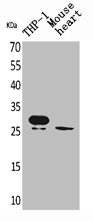
The antibody against TREM1 was raised in rabbit using the Synthesized peptide derived from the Internal region of Human TREM-1. as the immunogen. This antibody exists as a non-conjugated isotype IgG. The antibody was affinity-purified from rabbit antiserum by affinity-chromatography using epitope-specific immunogen. This antibody has been validated on WB, ELISA.
$167.00
| Cat.No | ADC-37216A | Clonality | Polyclonal |
|---|---|---|---|
| Host Species | Rabbit | Target Name | TREM1 |
| Form | Liquid | Species Reactivity | Human |
| Isotype | IgG | Storage Buffer | 0.5% BSA and 0.02% sodium azide., Liquid in PBS containing 50% glycerol |
| Purification Method | The antibody was affinity-purified from rabbit antiserum by affinity-chromatography using epitope-specific immunogen. | Conjugate | Non-conjugated |
| Application | ELISA, WB | Storage | Upon receipt |
| Immunogen Description | Synthesized peptide derived from the Internal region of Human TREM-1. | Target Species | Human |
|---|---|---|---|
| Immunogen Sequence | Complete sequences for the immunogen, target protein, and peptides are available upon request. | Uniprot ID | Q9NP99 |
Uniprot Id
Q9NP99
Target Species
Human
Target Name
TREM1
Target Full Name
Triggering receptor expressed on myeloid cells 1
Target Function
Cell surface receptor that plays important roles in innate and adaptive immunity by amplifying inflammatory responses. Upon activation by various ligands such as PGLYRP1, HMGB1 or HSP70, multimerizes and forms a complex with transmembrane adapter TYROBP/DAP12. In turn, initiates a SYK-mediated cascade of tyrosine phosphorylation, activating multiple downstream mediators such as BTK, MAPK1, MAPK3 or phospholipase C-gamma. This cascade promotes the neutrophil- and macrophage-mediated release of proinflammatory cytokines and/or chemokines, as well as their migration and thereby amplifies inflammatory responses that are triggered by bacterial and fungal infections. By also promoting the amplification of inflammatory signals that are initially triggered by Toll-like receptor (TLR) and NOD-like receptor engagement, plays a major role in the pathophysiology of acute and chronic inflammatory diseases of different etiologies including septic shock and atherosclerosis.; Acts as a decoy receptor, counterbalancing TREM1 proinflammatory activity through the neutralization of its lignad.
Target Subcellular Location
[Isoform 1]: Cell membrane; Single-pass type I membrane protein.; [Isoform 2]: Secreted.
Target Tissue Specificity
Mostly expressed by immune cells of the myeloid lineage, such as monocytes, macrophages, neutrophils and dendritic cells. Expression is associated with a mature stage of myeloid development. Highly expressed in adult liver, lung and spleen than in corresp
Target Synonyms
CD354; OTTMUSP00000018206; TREM 1; TREM-1; TREM1; TREM1_HUMAN; Triggering receptor expressed on monocytes 1; Triggering receptor expressed on myeloid cells 1; Triggering receptor TREM 1; Triggering receptor TREM1
Target Background
This gene encodes a receptor belonging to the Ig superfamily that is expressed on myeloid cells. This protein amplifies neutrophil and monocyte-mediated inflammatory responses triggered by bacterial and fungal infections by stimulating release of pro-inflammatory chemokines and cytokines, as well as increased surface expression of cell activation markers. Alternatively spliced transcript variants encoding different isoforms have been noted for this gene.
Notification